AI TaskWhat moved, appeared or changed
Change and Motion Detection
Change and motion detection identifies what differs between frames or between a scene and its reference — movement, new objects, removed objects or altered conditions. It is a lightweight first stage for many video pipelines and a direct answer to the question of whether anything changed.
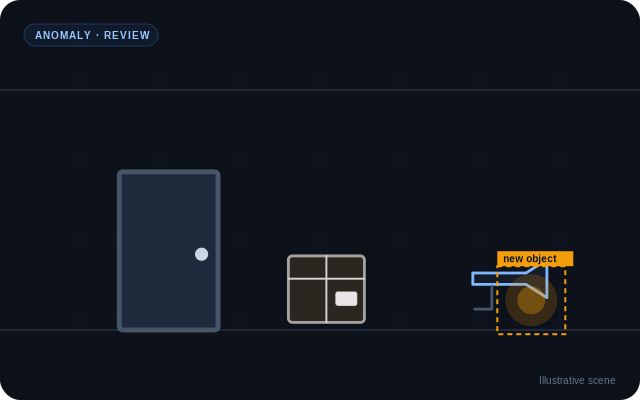
Definition
Motion detection compares consecutive frames or a learned background model to find moving regions. Change detection compares a scene with a reference — an earlier image or an approved state — to find what appeared, disappeared or changed. Learned models make both more robust to lighting and weather.
Typical outputs
- Regions of motion or change per frame
- Appeared, removed or altered objects relative to a reference
- Triggers that start heavier analysis only when needed
Where it is used
Event triggering
Starting detection or recording only when something moves, on low-power devices.
Before-and-after checks
Comparing an area, rack or asset with its approved state to spot missing or added items.
Camera tamper awareness
Noticing when a camera is covered, moved or defocused.
How it works
Motion detection models the background and highlights pixels that differ from it. Change detection compares the current scene with a reference image or state, often after aligning the two views. Learned methods suppress changes caused by light, shadows and weather.
A building block
In most EdgeTech pipelines, change and motion detection decide when heavier analysis runs, or provide the before-versus-after comparison that a use case needs.
Edge considerations
Because it is lightweight, change detection suits battery- and solar-powered devices and keeps bandwidth low by sending only frames where something happened.
Running it at the edge
Model, resolution, frame rate and hardware are planned together for each project.
Design considerations
- Very light compute. Classic motion detection costs little and can gate heavier models, saving power and bandwidth.
- Lighting and weather. Shadows, rain and lighting changes cause false changes unless handled by learned or adaptive methods.
- Camera stability. Vibration and camera movement must be compensated for change detection to stay reliable.
Limitations & scope
- Motion alone does not say what moved; it is usually combined with detection.
- Busy scenes with constant movement give little useful change signal.
- Reference images must be kept current as normal conditions evolve.
Proof of Concept
Have a visual AI challenge? Let's prove it.
Share a video of what happens in your environment and describe the outcome you need. We review every request for technical feasibility, then agree the scope of a focused Proof of Concept (PoC) with you.
Example request: “We want to know when equipment is removed from a secured cage compared with its normal state each night.”
Every request is reviewed for technical feasibility. PoC scope, timing and terms are agreed individually.
Frequently asked questions
Is motion detection still useful with modern AI models?
Yes. It is a cheap first stage that reduces how often heavier models must run, which matters on Edge devices.
Can it detect objects that were removed?
Change detection against a reference can flag missing objects, such as equipment no longer in its place.
Related topics
How this page connects to industries, use cases, AI tasks, input sources and deployment options.