Edge AI video intelligence solutions and services
Edge AI Video Intelligence
Video analytics at the edge. Intelligence wherever visual data is generated.
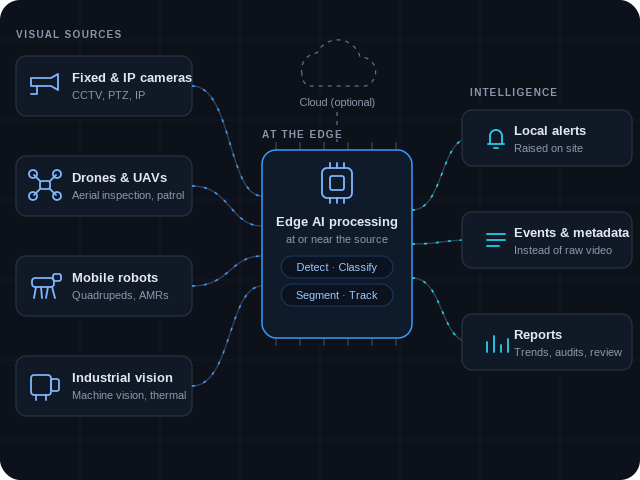
EdgeTech delivers AI-powered video analytics services that process visual data at or near its source — from cameras and drones to mobile robots and industrial vision systems. When a project needs additional computing, storage or centralized analytics, Cloud capabilities can complement the Edge architecture.
Your video. Your challenge.
Have a visual AI challenge? Let's prove it.
You don't need an existing AI system, a technical specification or a ready-made solution to get started.
Show us what happens in your environment. Share a video, describe the challenge, and our team will explore how Edge AI video intelligence can address it — from your real-world footage to a focused Proof of Concept (PoC), and a clear path toward deployment.
Every request is reviewed for technical feasibility. PoC scope, timing and delivery are agreed individually.
To get started, you don't need
- An existing AI system
- A technical specification
- Previous AI experience
- A chosen hardware platform
- A finished project plan
What helps
- A short, representative video or a secure link
- A plain-language description of the outcome you need
Why process video at the edge
Video is heavy, time-sensitive and often sensitive. Processing it close to where it is captured is usually the most practical starting point.
Decisions where events happen
Analysis runs at or near the source, so alerts do not depend on a round trip to a remote data center.
Less video in transit
Sending events and metadata instead of continuous video reduces bandwidth needs and transfer costs.
Control over visual data
Footage can stay on infrastructure you control, which simplifies privacy, security and data-residency requirements.
Works with limited connectivity
Edge systems keep operating at remote sites and on mobile platforms where networks are slow or intermittent.
Right-sized compute
Hardware is selected for the actual streams, resolution and models, rather than a one-size-fits-all configuration.
Cloud when it adds value
Central dashboards, long-term storage or model training can complement the Edge when a project needs them.
Any visual source, one approach
EdgeTech is not tied to one camera, drone or robot. The architecture is designed around the sources you have or plan to use, and compatibility is verified for each project.
Operational problems we help address
Projects start from a concrete problem with a clear owner. These are common starting points across industries; each is assessed for feasibility on your site.
PPE compliance
Check required protective equipment in defined zones, with human review of uncertain cases.
Quality inspection
Flag possible defects and deviations on products, surfaces and assemblies for confirmation.
Perimeter monitoring
Watch fences and boundaries of large or remote sites, from fixed or aerial viewpoints.
Workplace safety
Detect people entering hazardous zones around machinery, vehicles or robot cells.
Equipment monitoring
Observe equipment states, gauges and the visual condition of machines and assets.
Production line monitoring
Understand blockages, stoppages and flow through a production or packing process.
How it fits together
Every solution connects six decisions. The relationships are many-to-many: one use case spans several industries, one task supports many use cases, and one source can feed different compute platforms.
- 01 · IndustryManufacturing
- 02 · Use casePPE compliance
- 03 · AI tasksObject detection + tracking
- 04 · Visual sourceExisting IP camera
- 05 · ComputeEdge AI computer on site
- 06 · DeploymentEdge-only, local alerts
Illustrative example. It shows how the decisions relate — not a statement that a specific combination has already been delivered.
AI tasks
The computer vision capabilities are chosen for the problem — a label, a location, an exact outline, body keypoints, text or a count.
Explore AI tasksHardware & deployment
Compute is selected for each project: embedded modules such as NVIDIA Jetson, industrial Edge AI computers or other accelerators. Deployments range from Edge-only to hybrid Edge + Cloud.
- Sized to streams, resolution, models and latency targets
- Cloud added only when it adds clear value
From your video to a deployment path
A short, structured path keeps risk low and results measurable. Not every request leads to a PoC, and a successful PoC does not by itself guarantee production performance — each step is agreed with you.
- 1
Share your video
Upload a short clip or a secure link, and describe what happens in it.
- 2
Describe the outcome
Tell us what should be detected, counted, read or measured — in plain language.
- 3
Feasibility review
We assess whether the problem is technically suitable for Edge AI video analysis.
- 4
Agree scope and terms
If it is a fit, we propose the PoC scope, data needs, timeline and commercial terms.
- 5
Focused PoC
We build and run the agreed PoC and review the results against the agreed objectives.
- 6
Path to deployment
If the PoC succeeds and terms are agreed, we plan hardware, architecture and rollout.
Industries we work across
Wherever operations depend on what can be seen, Edge AI video intelligence can help. Each guide covers typical challenges, sources and deployment constraints.
- Aerospace
- Agriculture
- Airports
- Animal Monitoring
- Automotive
- Automotive Services
- Banking and Finance
- Construction
- Consumer Goods
- E-commerce Fulfillment
- Education Campuses
- Electronics and Semiconductors
- Energy
- Environmental Monitoring
- Facilities and Real Estate
- Food and Beverage
- Healthcare Facilities
- Hospitality and Food Service
- Infrastructure
- Logistics
- Manufacturing
- Media and Broadcasting
- Metals and Steel
- Mining
- Oil and Gas
- Pharmaceuticals
- Ports and Maritime
- Recycling and Waste Management
- Retail
- Robotics and Automation
- Smart Cities
- Sports Analytics
- Telecommunications
- Textiles
- Transportation and Rail
- Utilities
- Warehousing
From the blog
Practical articles on Edge AI video analytics, architecture choices and how to prepare a Proof of Concept.
- HardwareChoosing Hardware for Edge AI Video ProcessingEdge AI hardware ranges from compact AI boxes to industrial computers with discrete GPUs. This article explains the factors that drive hardware selection for video analytics — streams, models, latency, power, environment and cost — and why measurement beats generic figures.Read the article
- IndustriesCommon Challenges in Industrial Video AnalyticsIndustrial video analytics projects rarely fail because of the AI model alone. This article covers the practical challenges that most often decide success — camera placement, lighting, data, change over time, integration, privacy and operations — and how to address them early.Read the article
- ArchitectureEdge AI vs Cloud Video Analytics — How to ChooseShould video be analyzed at the edge or in the Cloud? The answer depends on latency, connectivity, bandwidth, privacy, compute needs and cost. This article compares both approaches and explains why many projects end up Edge-first with Cloud where it adds value.Read the article
About EdgeTech
EdgeTech is an engineering and solution-delivery provider specializing in Edge AI video intelligence. We help organizations turn visual data into actionable information by designing, building and supporting video analytics that run at or near the source.
Our work covers the path from operational problem to working system: assessing visual sources, selecting computer vision tasks and models, sizing Edge hardware, integrating with existing systems and supporting the solution after deployment.
The team brings together machine learning operations, backend engineering, interface design and data science. Hardware, models and software are the tools; the outcome is a solution engineered for your operation.
Contact
- AddressUnit 112, 3rd floor, Rasis Business Center, Al Barsha 1, Dubai, UAE
Technical Support
Email: support@edgetec.ai
- Telegram:@edgetech_ai_support
- WhatsApp:@edgetech_ai_support
CEO Contact
Email: ceo@edgetec.ai
Proof of Concept
Have a visual AI challenge? Let's prove it.
Share a video of what happens in your environment and describe the outcome you need. We review every request for technical feasibility, then agree the scope of a focused Proof of Concept (PoC) with you.
Every request is reviewed for technical feasibility. PoC scope, timing and terms are agreed individually.