Use CaseNew graffiti and damage on public assets
Graffiti and Vandalism Detection
Detect new graffiti, broken glass and visible damage on buildings, transit assets and street furniture so maintenance crews can respond sooner.
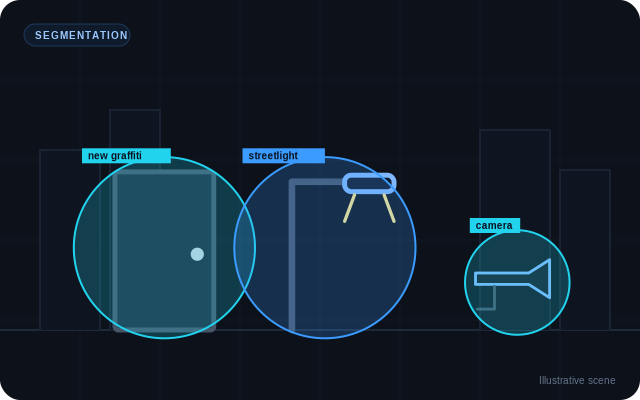
What can be checked
- New graffiti on walls and vehicles
- Broken glass and damaged fixtures
- Changes on monitored surfaces
What the team receives
- Maintenance alerts with images
- Hotspot statistics
What the solution does
Faster cleanup
Detects new graffiti and visible damage on monitored surfaces, so maintenance crews can remove it sooner after it appears.
Hotspot maps
Records where and when incidents occur, so owners can identify recurring hotspots and target prevention or lighting.
Asset records
Documents damage for maintenance planning.
The operational problem
Graffiti and vandalism spread when not removed quickly, but damage is often reported late.
How visual intelligence helps
Cameras compare monitored surfaces with their clean state and detect new graffiti or damage, alerting maintenance crews.
Example visual workflow
- Cameras or vehicle cameras capture surfaces.
- Changes and graffiti are detected.
- Alerts with locations are sent.
- Crews schedule cleaning or repair.
Illustrative workflow — the actual pipeline is designed for each site during the PoC.
Edge deployment considerations
Edge devices at depots or on vehicles analyze images locally and send only alerts and images of the affected surface.
How the solution is built
AI capabilities
The AI tasks this use case combines.
- Change and Motion Detection
Change and motion detection identifies what differs between frames or between a scene and its reference — movement, new objects, removed objects or altered conditions.
- Semantic Segmentation
Semantic segmentation assigns a class to every pixel of an image — road, floor, water, smoke, crop, background — producing a map of regions rather than individual objects.
Visual inputs
Cameras and imaging that typically supply the video.
- CCTV and Existing Surveillance Systems
Many sites already run CCTV systems — analog cameras, DVRs, NVRs and video management systems.
- Vehicle-Mounted Cameras
Cameras on trucks, rail vehicles, forklifts, buses and service vehicles capture visual data while moving — for road and rail inspection, operational safety and fleet operations.
Deployment options
General approaches to evaluate, not tested hardware. Specific hardware is selected and validated for each project during the PoC.
- Camera and VMS Integration
Most projects start with cameras that are already installed.
- Edge AI Hardware Sizing
Sizing Edge AI hardware means matching compute, memory, power and enclosure to the real workload — the number of streams, resolution, frame rate, models and latency targets — under the site's environmental and installation constraints.
- Edge Deployment Architectures
Edge-first means processing video at or near where it is captured.
- Standalone Edge AI Devices
Standalone Edge AI devices are compact, self-contained units — AI boxes or smart cameras — that process video locally at a single location.
Practical factors to plan for
Real-world results depend as much on the environment and camera setup as on the model.
Site and setup
- Change reference. Detecting new graffiti needs reference images of clean surfaces.
- Privacy. Analytics focus on surfaces and objects, not people.
Human review
Maintenance staff verify and schedule cleaning or repair. The system does not identify people.
Limitations & scope
- Graffiti similar to existing artwork or signage may be confused.
- Enforcement use is subject to legal limits.
Proof of Concept
Have a visual AI challenge? Let's prove it.
Share a video of what happens in your environment and describe the outcome you need. We review every request for technical feasibility, then agree the scope of a focused Proof of Concept (PoC) with you.
Example request: “We want to detect new graffiti on our tram fleet from depot entry cameras.”
Every request is reviewed for technical feasibility. PoC scope, timing and terms are agreed individually.
Related topics
How this page connects to industries, use cases, AI tasks, input sources and deployment options.