Content pillar · AI Tasks
AI tasks: the computer vision building blocks
The technical capabilities that interpret images and video — detecting, classifying, segmenting, tracking, reading and measuring. They are selected according to the operational problem, not the other way round, and sized for the Edge hardware that runs them.
Most video analytics combine more than one task. Object tracking is described as a processing mode built on detection rather than a standalone task, and every task has a different compute cost, so task selection and hardware sizing are planned together for every project at the edge.
Browse ai tasks
Showing 1–12 of 21 ai tasks
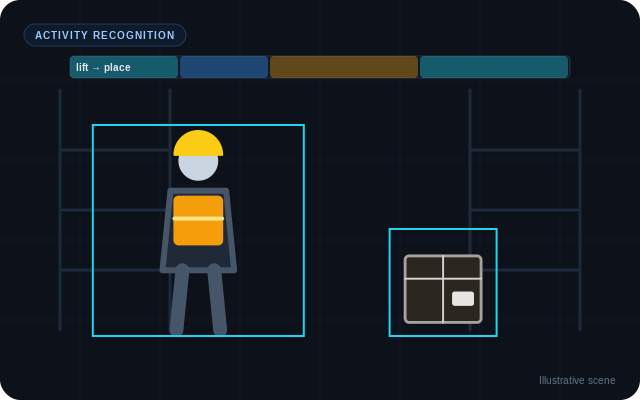 Understanding what happens over timeAction and Activity RecognitionAction recognition identifies short actions — picking, lifting, opening a door — while activity recognition describes longer sequences such as a loading operation or a procedure. Both analyze motion over multiple frames rather than single images.View details
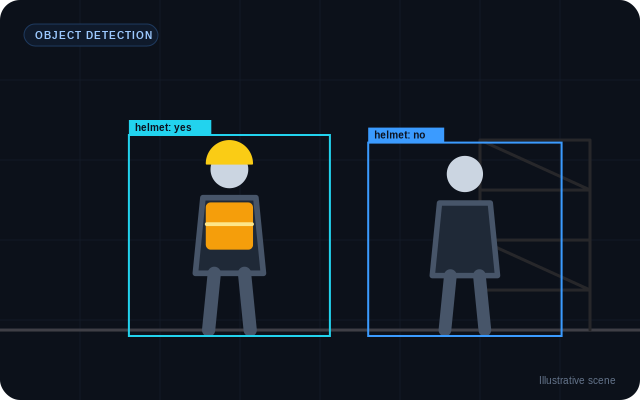 Properties of detected objectsAttribute RecognitionAttribute recognition determines properties of an object found by a detector — color, type, state, whether a helmet or vest is worn, whether a door is open. It adds descriptive detail to detection without identifying individuals.View details
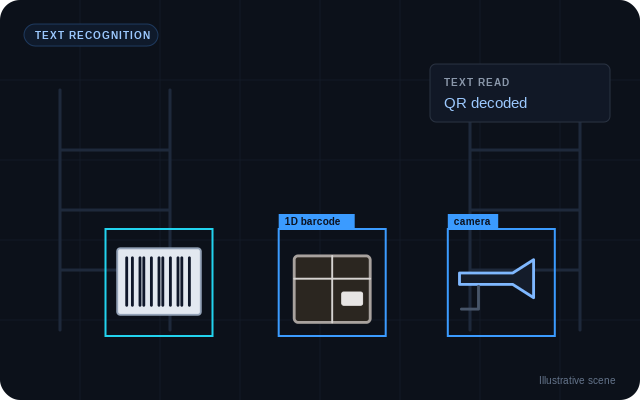 Locating and decoding printed codesBarcode and QR Code ReadingBarcode and QR code reading locates 1D barcodes, 2D codes such as QR and Data Matrix, and decodes their content from camera images — including codes that are small, angled, partly damaged or moving past on a conveyor.View details
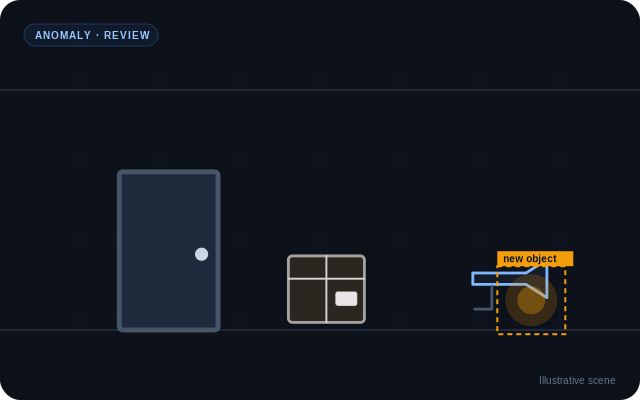 What moved, appeared or changedChange and Motion DetectionChange and motion detection identifies what differs between frames or between a scene and its reference — movement, new objects, removed objects or altered conditions. It is a lightweight first stage for many video pipelines and a direct answer to the question of whether anything changed.View details
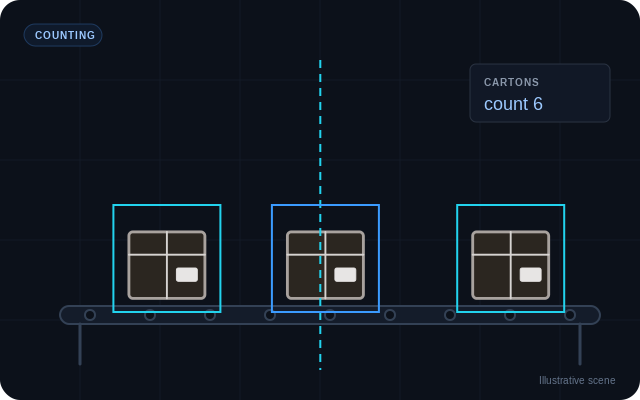 Turning detections into numbersCounting and MeasurementCounting and measurement convert detections, tracks and masks into quantities — how many objects, how long they stayed, how big they are, how full an area is. They are the bridge between computer vision outputs and operational metrics.View details
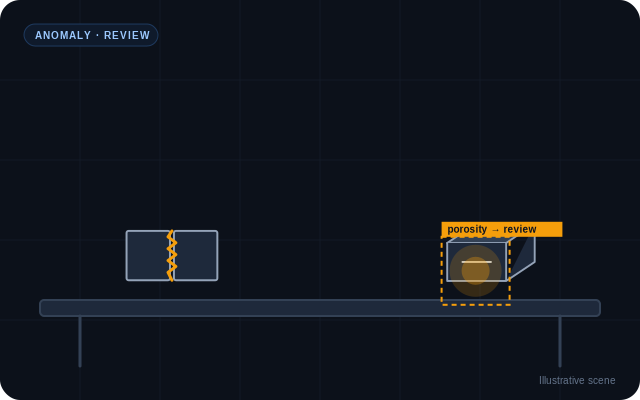 Locating known defect typesDefect DetectionDefect detection locates and classifies specific, known defect types — scratches, cracks, dents, contamination, missing features — in images of products or assets. It combines detection or segmentation with carefully defined defect classes.View details
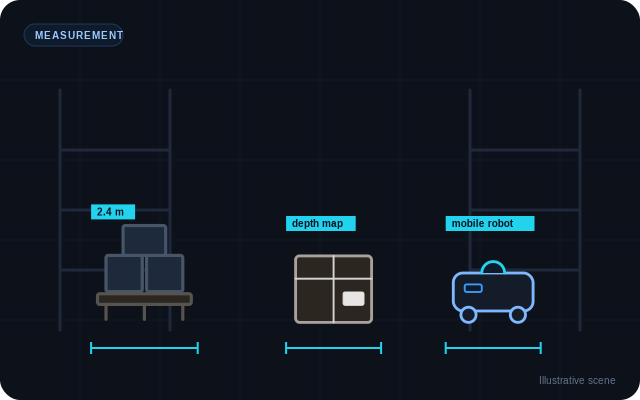 Distance and 3D structure from camerasDepth EstimationDepth estimation recovers how far each part of a scene is from the camera, using stereo or depth sensors or learned monocular models. Depth turns flat detections into positions, volumes and distances that robots, measurement and safety awareness can use.View details
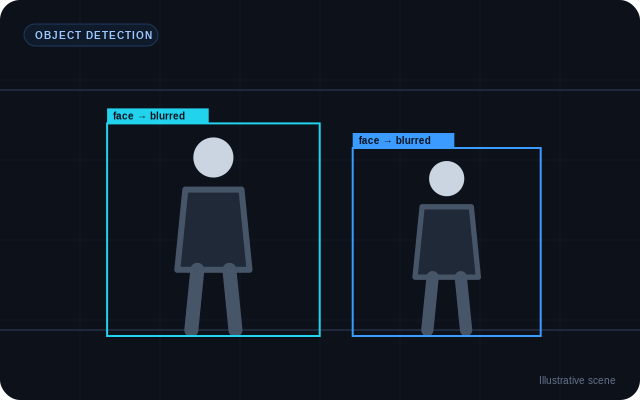 Detection only, with strict limitsFace DetectionFace detection locates faces in an image without determining who they are. Its most responsible uses are privacy-protecting ones, such as automatically blurring faces in footage before storage or sharing. Face recognition — identifying individuals — is a different capability and is not offered here.View details
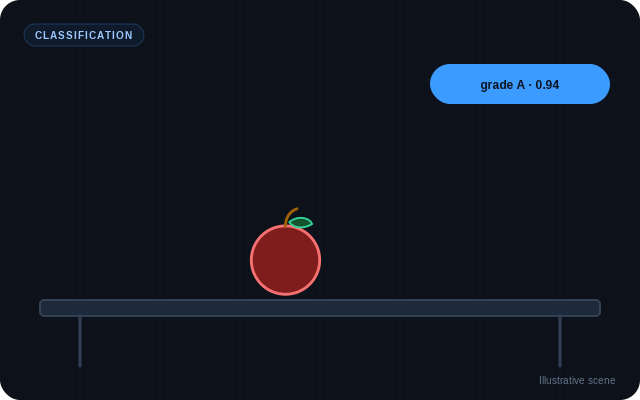 Core computer vision taskImage and Object ClassificationClassification assigns a label to a whole image or to an individual object crop — good or defective, running or stopped, product variant A or B. It is the simplest output and often the most efficient choice when location is not needed.View details
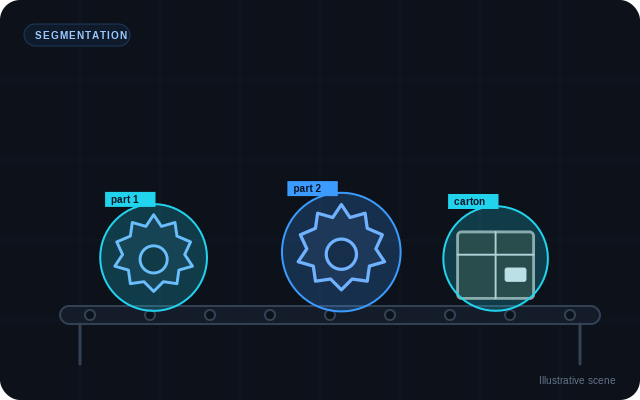 Core computer vision taskInstance SegmentationInstance segmentation detects each object and outlines its exact pixels — a separate mask per object. It combines the "which object" of detection with the "exact shape" of segmentation, for measurement and precise inspection.View details
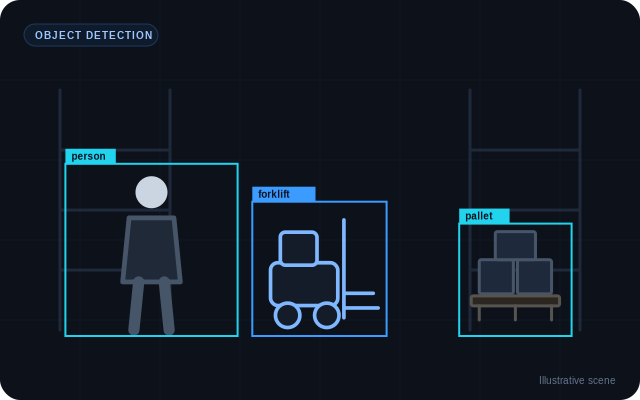 Core computer vision taskObject DetectionObject detection finds and labels the objects in an image or video frame and marks each one with a bounding box. It is the starting point for many video analytics use cases, from PPE compliance to aerial inspection.View details
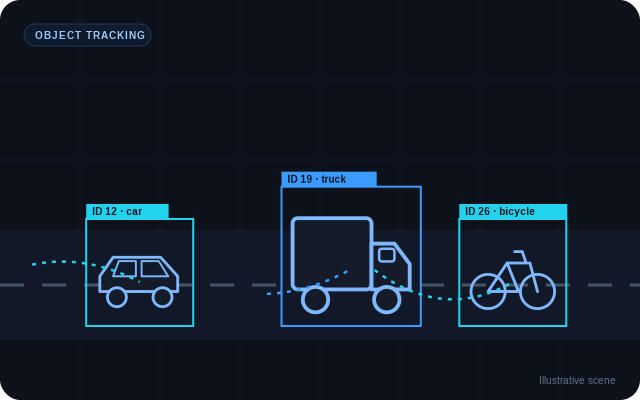 Processing mode across framesObject Tracking and Multi-Object TrackingObject tracking links detections of the same object across consecutive video frames and assigns each one a persistent ID. It turns per-frame detections into movement, counts, dwell times and events — and is a processing mode built on detection rather than a separate business application.View details
No ai tasks match your search.
Try fewer words or clear a filter. If your challenge is not listed, you can still describe it in a PoC request.
Proof of Concept
Have a real detection, tracking or inspection problem?
Let's assess it. Share a short video and describe what needs to be detected, read, counted or measured — no technical specification needed.
Every request is reviewed for technical feasibility. PoC scope, timing and terms are agreed individually.