AI TaskDetection only, with strict limits
Face Detection
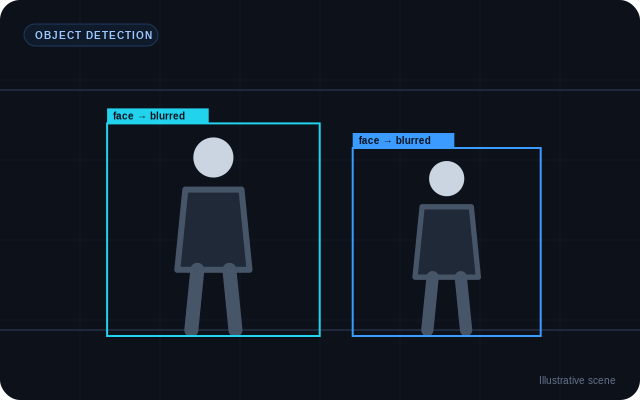
Face detection locates faces in an image without determining who they are. Its most responsible uses are privacy-protecting ones, such as automatically blurring faces in footage before storage or sharing. Face recognition — identifying individuals — is a different capability and is not offered here.
Definition
Face detection predicts the location of human faces in an image, typically as bounding boxes with confidence scores, without extracting identity information. It is distinct from face recognition, which compares faces against identities.
Typical outputs
- Bounding boxes for detected faces
- Confidence per detection
- Blurred or masked output frames, when used for anonymization
Where it is used
Privacy-preserving storage
Blurring faces in stored or shared footage to reduce exposure of personal data.
Data preparation
Anonymizing footage before it is used for model development or shared with partners.
Counting support
Supporting presence detection in specific setups where other person-detection approaches are less suitable.
Detection is not recognition
Face detection answers “is there a face, and where?”. Face recognition answers “whose face is this?”. These are different capabilities with very different legal and ethical implications. EdgeTech’s scope is limited to detection for legitimate, privacy-protecting purposes.
Privacy by design at the edge
The most valuable use of face detection is to protect privacy: blurring faces on the Edge device before footage is stored, transmitted or used for model development.
Legal and operational appropriateness
Even face detection processes personal data. Any use requires a legal basis, transparency and an assessment under applicable data-protection law. Where it is not appropriate, it is not used.
Running it at the edge
Model, resolution, frame rate and hardware are planned together for each project.
Design considerations
- Anonymize at the source. Detecting and blurring faces on the Edge device means identifiable footage never leaves the site.
- Missed faces matter. For anonymization, missed faces are the main risk; detection thresholds favor recall and are validated per camera.
- Small faces. Distant or angled faces are harder to detect; camera placement affects anonymization coverage.
Limitations & scope
- Face recognition, identification and biometric profiling are outside the scope of EdgeTech's offering.
- Face detection still processes personal data; its use must have a legal basis and comply with applicable law.
- No detector finds every face; anonymization should be verified and combined with other safeguards.
Proof of Concept
Have a visual AI challenge? Let's prove it.
Share a video of what happens in your environment and describe the outcome you need. We review every request for technical feasibility, then agree the scope of a focused Proof of Concept (PoC) with you.
Every request is reviewed for technical feasibility. PoC scope, timing and terms are agreed individually.
Frequently asked questions
Do you offer face recognition?
No. This page covers face detection only — locating faces, mainly in order to blur them. Identifying people is not part of EdgeTech's offering.
Why use face detection at all?
Its main value here is privacy protection — automatically blurring faces in footage so that analysis, storage or sharing exposes less personal data.
Related topics
How this page connects to industries, use cases, AI tasks, input sources and deployment options.