Input SourceFirst-person views for field teams
Body-Worn and Wearable Cameras
Body-worn and head-mounted cameras capture what field workers see — for remote assistance, inspection documentation and procedure verification. They raise significant privacy considerations and are used with clear purposes and safeguards.
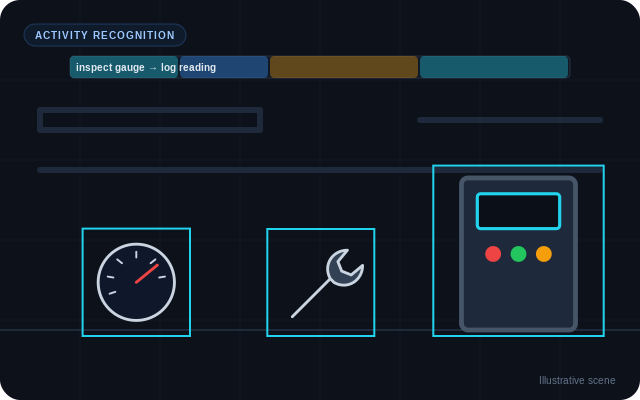
Where processing can run
- Paired device. Video is processed on a paired phone or tablet carried by the worker.
- Local Edge server. Footage is uploaded on site to an Edge server for analysis after the task.
- Hybrid. Simple checks run on the paired device; detailed analysis runs later on site or centrally.
What this source enables
Inspection documentation
Capturing inspection rounds and highlighting items for follow-up.
Procedure verification
Checking visible steps of maintenance or assembly procedures after the task.
Remote assistance support
Adding recognition of equipment or labels to remote-assistance sessions.
Seeing through the worker’s eyes
Wearable cameras capture tasks from the perspective of the person performing them. That makes them useful for documenting inspections and verifying procedures — and makes privacy safeguards especially important.
Processing options
Wearable devices are constrained in power and compute. Analysis typically runs on a paired device or an Edge server, often after the task is complete.
Responsible use
Body-worn cameras require clear purposes, legal review and transparent communication with the people wearing them and those around them.
What to consider
Practical factors that determine which architecture and models are feasible.
Platform and mission
- Privacy and consent. Wearable cameras record the wearer's surroundings, including other people; clear purposes, consent and safeguards are essential.
- Motion and viewpoint. First-person footage moves constantly and changes viewpoint, which makes analysis harder than with fixed cameras.
- Battery and compute. Wearable devices have limited power, so heavy analysis usually runs on a paired device or server.
Limitations & scope
- Use of body-worn cameras at work requires legal review, employee consultation and clear policies.
- First-person footage is variable; analytics are scoped to tasks that tolerate motion and viewpoint changes.
- Footage may capture bystanders; anonymization should be considered.
Proof of Concept
Have a visual AI challenge? Let's prove it.
Share a video of what happens in your environment and describe the outcome you need. We review every request for technical feasibility, then agree the scope of a focused Proof of Concept (PoC) with you.
Example request: “We want to check after each maintenance job that all inspection points in the procedure were visited.”
Every request is reviewed for technical feasibility. PoC scope, timing and terms are agreed individually.
Frequently asked questions
Is real-time analysis possible on body-worn cameras?
Simple checks can run on a paired device. Most analysis happens after the task, on site or centrally.
How is privacy protected?
Through clear purpose limitation, consent, retention rules and, where appropriate, automatic face blurring before storage.
Related topics
How this page connects to industries, use cases, AI tasks, input sources and deployment options.