Use CaseBlurring faces and plates in footage
Video Anonymization and Privacy Redaction
Detect and blur faces, people and license plates in live or recorded video so footage can be shared, stored or analyzed with less personal data — processed at the edge before video leaves the site.
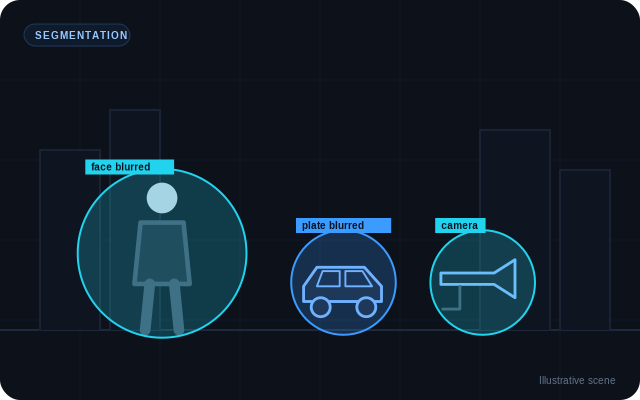
What can be checked
- Faces and heads
- Whole persons where required
- License plates
What the team receives
- Redacted video streams or files
- Redaction logs with coverage statistics
What the solution does
Privacy by design
Removes personal data before footage leaves the site.
Shareable footage
Makes video usable for training data and third parties.
Consistent tracking
Keeps blurring stable as people and vehicles move.
The operational problem
Organizations increasingly need to share or retain video while minimizing personal data. Manual redaction is slow and inconsistent, and sending raw footage elsewhere for processing creates exposure.
How visual intelligence helps
Detection and tracking find faces, people and plates frame by frame, and the regions are blurred or masked. Running this at the edge means only redacted video needs to be stored or transmitted.
Example visual workflow
- Video is captured by fixed or vehicle cameras.
- Faces and plates are detected and tracked across frames.
- Detected regions are blurred or masked.
- Redacted video is stored or shared and a log is kept.
Illustrative workflow — the actual pipeline is designed for each site during the PoC.
Edge deployment considerations
Redaction runs on Edge devices or on-premises servers close to the cameras. Raw footage can be discarded after processing, according to the agreed retention policy.
How the solution is built
AI capabilities
The AI tasks this use case combines.
- Face Detection
Face detection locates faces in an image without determining who they are.
- Object Tracking and Multi-Object Tracking
Object tracking links detections of the same object across consecutive video frames and assigns each one a persistent ID.
Visual inputs
Cameras and imaging that typically supply the video.
- Body-Worn and Wearable Cameras
Body-worn and head-mounted cameras capture what field workers see — for remote assistance, inspection documentation and procedure verification.
- IP and Network Cameras
IP cameras stream digital video over standard networks and are the most common source for Edge AI video analytics.
- Vehicle-Mounted Cameras
Cameras on trucks, rail vehicles, forklifts, buses and service vehicles capture visual data while moving — for road and rail inspection, operational safety and fleet operations.
Deployment options
General approaches to evaluate, not tested hardware. Specific hardware is selected and validated for each project during the PoC.
- Camera and VMS Integration
Most projects start with cameras that are already installed.
- Edge AI Hardware Sizing
Sizing Edge AI hardware means matching compute, memory, power and enclosure to the real workload — the number of streams, resolution, frame rate, models and latency targets — under the site's environmental and installation constraints.
- Edge Deployment Architectures
Edge-first means processing video at or near where it is captured.
- Standalone Edge AI Devices
Standalone Edge AI devices are compact, self-contained units — AI boxes or smart cameras — that process video locally at a single location.
Practical factors to plan for
Real-world results depend as much on the environment and camera setup as on the model.
Site and setup
- Recall over precision. Missing a face matters more than blurring an extra region; settings favor coverage.
- Small and turned faces. Distant or turned faces are harder to detect and need tuning and review.
Human review
High-stakes releases are reviewed before publication. Redaction reduces but does not guarantee removal of all personal data.
Limitations & scope
- Partially hidden, very small or unusual faces can be missed.
- Redaction does not remove other identifying details such as clothing or context.
Proof of Concept
Have a visual AI challenge? Let's prove it.
Share a video of what happens in your environment and describe the outcome you need. We review every request for technical feasibility, then agree the scope of a focused Proof of Concept (PoC) with you.
Example request: “We want to blur faces and plates in footage from our road survey vehicles before sharing it with contractors.”
Every request is reviewed for technical feasibility. PoC scope, timing and terms are agreed individually.
Frequently asked questions
Can anonymization run in real time?
Yes, on suitable Edge hardware. Real-time redaction allows only anonymized video to be stored or transmitted.
Related topics
How this page connects to industries, use cases, AI tasks, input sources and deployment options.