Use CaseSlag in the stream during tapping
Slag Carryover Detection
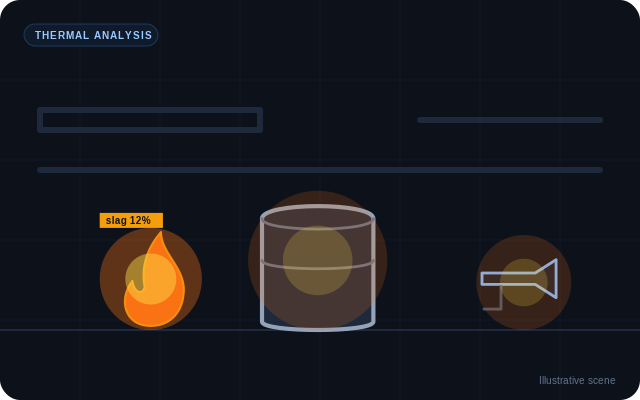
Detect slag in the metal stream during furnace or converter tapping with thermal and visual cameras, helping operators stop tapping before excessive slag carryover.
What can be checked
- Slag versus metal in the stream
- Slag share over time
- End-of-tap indicators
What the team receives
- Real-time slag indicator for operators
- Tapping records
What the solution does
Operator support
Gives an objective slag indicator during tapping.
Quality benefit
Provides an objective indicator of slag during tapping, which supports operators in reducing slag carried into the ladle.
Process records
Documents every tap with slag indicators for process review.
The operational problem
Slag carried over from furnaces into ladles affects steel quality and costs, but operators judge the end of tapping by eye in harsh conditions.
How visual intelligence helps
Thermal cameras distinguish slag from metal in the stream and give operators a real-time indicator of slag share during tapping.
Example visual workflow
- A thermal camera views the tapping stream.
- Slag and metal are distinguished frame by frame.
- The slag share is shown to the operator.
- Tapping records are stored.
Illustrative workflow — the actual pipeline is designed for each site during the PoC.
Edge deployment considerations
Processing runs on ruggedized Edge hardware in the melt shop with latency suited to operator decisions.
How the solution is built
AI capabilities
The AI tasks this use case combines.
- Semantic Segmentation
Semantic segmentation assigns a class to every pixel of an image — road, floor, water, smoke, crop, background — producing a map of regions rather than individual objects.
- Visual Anomaly Detection
Visual anomaly detection learns what normal looks like and flags images, regions or events that deviate from it.
Visual inputs
Cameras and imaging that typically supply the video.
- Thermal and Infrared Cameras
Thermal cameras image heat (long-wave infrared), while near-infrared cameras use invisible illumination to see in darkness.
Deployment options
General approaches to evaluate, not tested hardware. Specific hardware is selected and validated for each project during the PoC.
- Edge AI Hardware Sizing
Sizing Edge AI hardware means matching compute, memory, power and enclosure to the real workload — the number of streams, resolution, frame rate, models and latency targets — under the site's environmental and installation constraints.
- Edge Deployment Architectures
Edge-first means processing video at or near where it is captured.
- Industrial and Ruggedized Edge AI Computers
Industrial Edge AI computers and ruggedized systems house AI-capable processors in enclosures built for factories, vehicles and outdoor sites — wide temperature ranges, vibration, dust and industrial power.
Practical factors to plan for
Real-world results depend as much on the environment and camera setup as on the model.
Site and setup
- Thermal setup. Slag and steel are distinguished by emissivity differences in thermal images.
- Harsh environment. Cameras need protection from heat and fumes.
Human review
Operators decide when to stop tapping. The indicator supports, and does not control, the process.
Limitations & scope
- Smoke and fumes can obscure the stream.
- Indicators require validation against process results.
Proof of Concept
Have a visual AI challenge? Let's prove it.
Share a video of what happens in your environment and describe the outcome you need. We review every request for technical feasibility, then agree the scope of a focused Proof of Concept (PoC) with you.
Example request: “We want a real-time slag indicator for operators during converter tapping.”
Every request is reviewed for technical feasibility. PoC scope, timing and terms are agreed individually.
Related topics
How this page connects to industries, use cases, AI tasks, input sources and deployment options.