AI TaskCore computer vision task
Semantic Segmentation
Semantic segmentation assigns a class to every pixel of an image — road, floor, water, smoke, crop, background — producing a map of regions rather than individual objects. It suits problems about areas and surfaces.
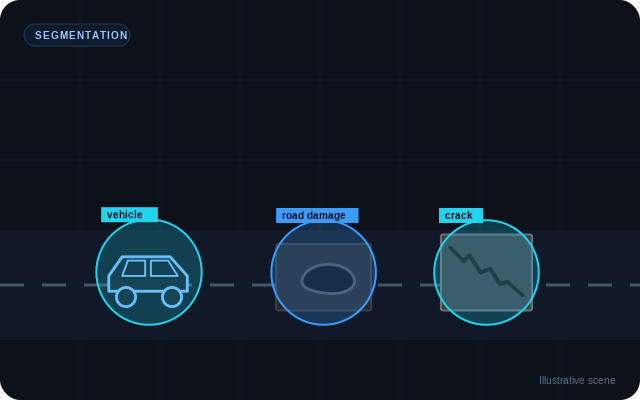
Definition
Semantic segmentation predicts a class label for each pixel in an image, grouping all pixels of the same class together without distinguishing individual object instances. The output is a label map the same size as the input image.
Typical outputs
- A per-pixel class map
- Area or coverage measurements per class
- Region boundaries for overlays and rules
Where it is used
Surfaces and spills
Outlining spills, water or debris on floors and outdoor surfaces.
Smoke and environmental areas
Estimating smoke regions, vegetation, water bodies or land cover.
Drivable and walkable areas
Separating roads, walkways and obstacles for mobile robots and vehicles.
How it works
A segmentation network processes the image and outputs, for each pixel, the most likely class. The result can be visualized as colored regions and measured as areas or proportions.
When areas matter more than objects
Many operational questions are about regions: how much of a floor is wet, where smoke is, how much of a field is affected. Semantic segmentation answers these directly, whereas bounding boxes would be a poor fit for irregular shapes.
Running it at the edge
Segmentation is heavier than detection, but many area-based use cases do not need high frame rates. Analyzing frames at intervals on Edge hardware keeps compute and power requirements practical.
Running it at the edge
Model, resolution, frame rate and hardware are planned together for each project.
Design considerations
- Resolution versus speed. Per-pixel outputs are compute-intensive; input resolution and model size are balanced against the required frame rate.
- Lower frame rates often suffice. Many area-based questions, such as spill or water coverage, change slowly and can be analyzed every few seconds.
- Post-processing. Masks are converted into areas, percentages or alerts on the Edge device so only results are transmitted.
Limitations & scope
- It does not separate individual objects of the same class; use instance segmentation when you need each object.
- Boundaries of soft or transparent regions, such as smoke or water, are inherently uncertain.
- Pixel-level labeling of training data is more effort than drawing boxes.
Proof of Concept
Have a visual AI challenge? Let's prove it.
Share a video of what happens in your environment and describe the outcome you need. We review every request for technical feasibility, then agree the scope of a focused Proof of Concept (PoC) with you.
Every request is reviewed for technical feasibility. PoC scope, timing and terms are agreed individually.
Frequently asked questions
What is the difference between semantic and instance segmentation?
Semantic segmentation labels pixels by class only. Instance segmentation also separates each object, so two adjacent pallets get two separate masks.
Is segmentation always better than detection?
No. It gives more detail but costs more compute and labeling effort. Use it when shape or area matters.
Related topics
How this page connects to industries, use cases, AI tasks, input sources and deployment options.
Industries
Use Cases
- Aerial Mapping and Feature Extraction
- AMR Obstacle Perception
- Bridge and Tunnel Inspection Support
- Composite Defect Inspection
- Corrosion Detection
- Crack Detection on Concrete and Structures
- Crop Disease Symptom Detection
- Crop Row Detection for Machine Guidance
- Crowd Density Estimation
- Fabric Defect Detection
- Fire and Smoke Detection
- Flood and Water Level Monitoring
- Gas Leak Indicators with Optical Imaging
- Graffiti and Vandalism Detection
- Industrial Visual Inspection
- Meat and Poultry Processing Inspection
- Oil Sheen and Spill Detection on Water
- Ore and Rock Type Classification
- Plant Growth Monitoring
- Pothole and Road Damage Detection
- Poultry House Monitoring
- Slag Carryover Detection
- Spill Detection
- Steel and Metal Surface Inspection
- Stockpile Volume Estimation
- Surface Scratch and Cosmetic Defect Detection
- Vegetation Encroachment Monitoring
- Waste Bin and Bunker Fill Monitoring
- Wastewater Process Monitoring
- Weed Detection for Targeted Treatment
- Wind Turbine Blade Inspection
- Wood and Lumber Defect Grading