Input SourceHeat and low-light imaging
Thermal and Infrared Cameras
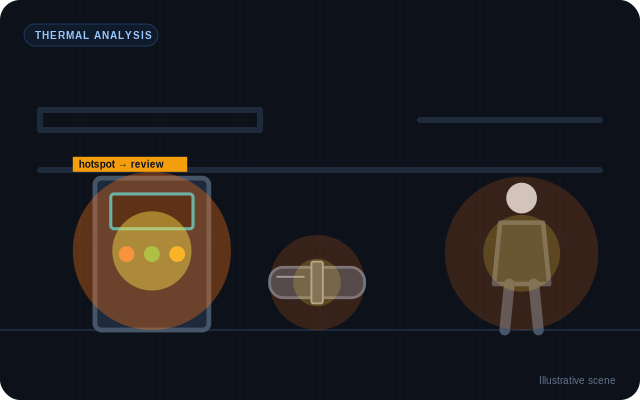
Thermal cameras image heat (long-wave infrared), while near-infrared cameras use invisible illumination to see in darkness. Both extend Edge AI video analytics to night operations, heat-related anomalies and conditions where visible cameras struggle.
Where processing can run
- Edge AI computer on site. Thermal streams are analyzed alongside visible streams on a local Edge AI computer.
- Onboard camera analytics. Some thermal cameras include onboard analytics; capabilities are assessed per model.
- Aerial thermal analysis. Drone thermal imagery is analyzed onboard capable platforms, on ground stations or post-flight.
What this source enables
Night and low-light detection
Detecting people and vehicles in darkness for perimeter and safety applications.
Heat anomalies
Highlighting unusual temperatures on electrical equipment, motors, panels or processes.
Smoke and fire awareness
Adding heat-based cues to visual smoke and flame detection.
Seeing what visible cameras cannot
Thermal imaging adds a different kind of information: heat. It works in complete darkness and reveals temperature patterns that indicate equipment problems or the presence of people and vehicles.
Combining thermal and visible
Many systems pair thermal cameras for detection with visible cameras for verification. Edge AI can process both streams on site and combine results into single events.
Interpreting thermal data responsibly
Thermal readings are affected by materials, reflections and weather. Analytics highlight anomalies for qualified staff to interpret, rather than producing final diagnostic conclusions.
What to consider
Practical factors that determine which architecture and models are feasible.
Platform and mission
- Thermal versus near-infrared. Thermal cameras detect emitted heat and need no light; near-infrared cameras need IR illumination and produce grayscale images similar to visible ones.
- Resolution. Thermal sensors usually have far lower resolution than visible cameras, which limits detection range and fine detail.
- Radiometric data. Radiometric thermal cameras provide temperature values per pixel; non-radiometric cameras provide only relative heat images.
- Emissivity and environment. Surface materials, reflections, sun and weather affect thermal readings and must be considered in interpretation.
Limitations & scope
- Thermal analysis indicates relative or estimated temperatures and does not replace qualified thermography.
- Low thermal resolution limits identification of small objects or details at distance.
- Glass and polished metal reflect or block thermal radiation, which affects what can be seen.
Proof of Concept
Have a visual AI challenge? Let's prove it.
Share a video of what happens in your environment and describe the outcome you need. We review every request for technical feasibility, then agree the scope of a focused Proof of Concept (PoC) with you.
Example request: “We want to compare thermal images of our switchgear over time and flag panels that run hotter than usual.”
Every request is reviewed for technical feasibility. PoC scope, timing and terms are agreed individually.
Frequently asked questions
Can thermal cameras measure exact temperatures?
Radiometric thermal cameras provide temperature estimates, but accuracy depends on emissivity, distance and environment. They are suited to detecting relative differences and trends.
Are thermal cameras better than visible cameras at night?
For detecting people and vehicles in darkness, often yes. For reading text or identifying details, visible or near-infrared cameras with lighting are needed.
Related topics
How this page connects to industries, use cases, AI tasks, input sources and deployment options.
Industries
- Edge AI Video Intelligence for Airports
- Edge AI Video Intelligence for Animal Monitoring
- Edge AI Video Intelligence for Energy
- Edge AI Video Intelligence for Environmental Monitoring
- Edge AI Video Intelligence for Infrastructure
- Edge AI Video Intelligence for Metals and Steel
- Edge AI Video Intelligence for Mining
- Edge AI Video Intelligence for Oil and Gas
- Edge AI Video Intelligence for Ports and Maritime
- Edge AI Video Intelligence for Utilities
Use Cases
- Airfield Wildlife Hazard Detection
- Animal Behavior Monitoring
- Driver Fatigue and Distraction Monitoring
- Equipment Monitoring
- Fall Detection in Care Settings
- Fire and Smoke Detection
- Flare Monitoring
- Foreign Object Debris (FOD) Detection
- Furnace and Ladle Monitoring
- Gas Leak Indicators with Optical Imaging
- Heavy Vehicle Proximity Awareness
- Industrial Visual Inspection
- Man-Down and Worker Fall Detection
- Oil Sheen and Spill Detection on Water
- Perimeter Monitoring and Intrusion Detection
- Pipeline Right-of-Way Monitoring
- Poultry House Monitoring
- Power Line Inspection
- Slab and Coil ID Reading
- Slag Carryover Detection
- Solar Panel Inspection
- Spill Detection
- Substation Monitoring
- Thermal Equipment Monitoring
- Vessel Detection and Tracking
- Wastewater Process Monitoring
- Wildfire Smoke Detection
- Wildlife Monitoring