Hardware & DeploymentDeployment architectures
Edge Deployment Architectures
Edge-first means processing video at or near where it is captured. This page explains the main deployment arrangements — Edge-only, Edge with Cloud services, and hybrid processing — and the trade-offs that decide which one fits a project.
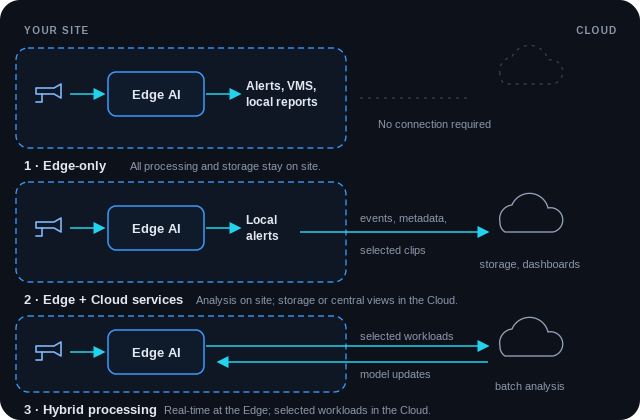
Deployment arrangements
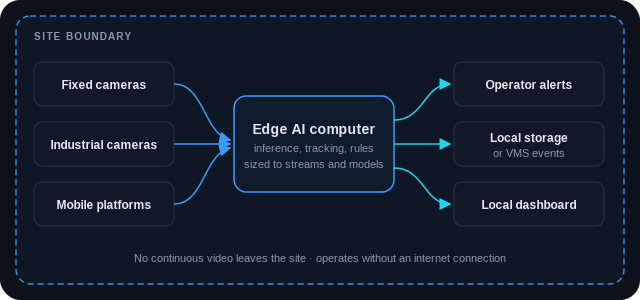
- Edge-only. Video is analyzed and stored on site. Alerts, events and dashboards stay on the local network, and no continuous video leaves the facility.
- Edge + Cloud services. Analysis still runs at the edge, while events, metadata and selected clips go to the Cloud for long-term storage or dashboards across several sites.
- Hybrid processing. Real-time analysis runs at the edge; selected workloads, such as heavy batch analysis or model improvement, run in the Cloud.
- Project-specific arrangements. For example, onboard compute on drones or robots, temporary processing for a proof of concept under agreed terms, or air-gapped sites.
Why Edge-first
Faster local decisions
Alerts are raised where the event happens, without waiting on a remote service.
Less data in transit
Sending events and metadata instead of continuous video reduces bandwidth and transfer costs.
Control over video
Footage can remain on site, which simplifies many privacy, security and data-residency requirements.
Works with limited connectivity
Edge systems keep operating when external networks are slow, intermittent or unavailable.
Right-sized hardware
Compute is chosen for the actual streams, resolution, frame rate and models — not a one-size-fits-all box.
Cloud where it helps
Central dashboards, long-term storage or model training can be added when they genuinely add value.
What Edge-first means
Edge-first means the default place to process video is at or near its source: on the device itself, on a computer in the same facility, or on a unit carried by a vehicle, robot or drone. Cloud capabilities complement the edge when a project needs more compute, storage or centralized analytics — they are not the starting assumption.
Choosing an architecture
The right arrangement follows from a few practical questions:
- How quickly must someone act on a result?
- Is the site connection reliable, and how much bandwidth is available?
- May video leave the site, and where may data be stored?
- How many streams are there, at what resolution and frame rate?
- How complex are the models, and will they need retraining?
- What power, space, temperature and dust conditions does the hardware face?
Compute hardware
Edge AI hardware ranges from embedded modules to industrial computers with discrete GPUs. NVIDIA’s Jetson family — including Jetson Orin Nano, Orin NX, AGX Orin and Jetson Thor — covers a wide range of compute, memory and power envelopes and is a current focus for EdgeTech. It is not the only option: industrial PCs, other embedded GPUs and dedicated AI accelerators can be the better choice for a given project. Exact figures, such as compute performance and power modes, are taken from manufacturer datasheets for the specific module and measured with the actual models during a proof of concept.
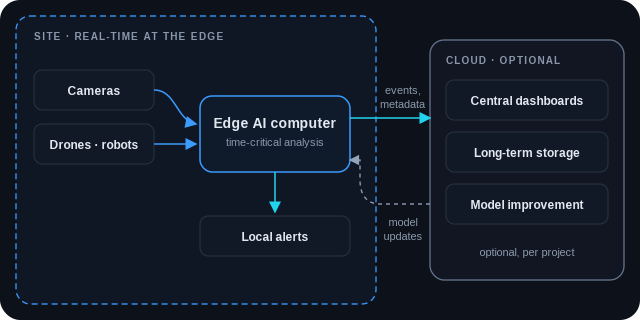
Edge and Cloud: practical trade-offs
Neither option is better in every respect. The right balance depends on the latency, connectivity, data and cost requirements of the project.
| Factor | Processing at the Edge | Processing in the Cloud |
|---|---|---|
| Latency | Decisions are made on site, without a round trip to a remote data centre. | Adds network round-trip time; suited to analysis that is not time-critical. |
| Connectivity | Can operate offline or with intermittent links. | Needs a dependable connection for the workloads it runs. |
| Bandwidth | Only events and metadata need to leave the site. | Continuous video upload grows costly with resolution and stream count. |
| Privacy and data residency | Video can stay on infrastructure you control. | Data leaves the site; storage location and access must be governed. |
| Compute capacity | Fixed by the installed hardware, so it is sized to the streams and models. | Elastic; useful for heavy batch analysis and model training. |
| Operating cost | Upfront hardware plus maintenance, with predictable running costs. | Usage-based; grows with video volume and processing. |
| Resilience and operations | A failure affects one site; needs an on-site maintenance plan. | Centrally managed; depends on network availability. |
Hardware references and compatibility status
Statements are limited to what manufacturers document officially. Listing a product does not imply a partnership with EdgeTech or a completed integration; compatibility is verified for each project.
| Platform | What the manufacturer states | Status | Source |
|---|---|---|---|
| NVIDIA Jetson | NVIDIA's current Jetson module families include Jetson Orin Nano, Jetson Orin NX, Jetson AGX Orin and Jetson Thor, spanning different compute, memory and power envelopes.Note: Per-module figures (TOPS, memory, power modes) vary by SKU and precision and must be taken from NVIDIA's module datasheets for each project. | Officially verified | Official pageChecked 2026-11-21 |
Limitations & scope
- Edge hardware has fixed capacity. It must be sized for the number of streams, resolution, frame rate and models, and sizing is confirmed during design.
- On-site deployments need power, networking, physical security, environmental protection and a maintenance arrangement.
- AI models need monitoring and periodic updates after deployment, which is part of ongoing support.
Proof of Concept
Have a visual AI challenge? Let's prove it.
Share a video of what happens in your environment and describe the outcome you need. We review every request for technical feasibility, then agree the scope of a focused Proof of Concept (PoC) with you.
Every request is reviewed for technical feasibility. PoC scope, timing and terms are agreed individually.
Frequently asked questions
Is Cloud required?
No. Many projects run entirely at the edge. Cloud services are proposed only when they add clear value, such as multi-site dashboards, long-term storage or model training.
Do you only use NVIDIA Jetson hardware?
No. NVIDIA Jetson modules are a common choice for embedded Edge AI and a current focus, but hardware is selected per project. Industrial PCs with GPUs or other AI accelerators may suit some projects better.
Can existing cameras and recorders be used?
Often, yes. Many projects start from existing cameras and video management systems. Compatibility of streams, formats and resolution is confirmed during assessment.
Related topics
How this page connects to industries, use cases, AI tasks, input sources and deployment options.