Architecture
Edge AI vs Cloud Video Analytics — How to Choose
Should video be analyzed at the edge or in the Cloud? The answer depends on latency, connectivity, bandwidth, privacy, compute needs and cost. This article compares both approaches and explains why many projects end up Edge-first with Cloud where it adds value.
EdgeTech editorial team ·
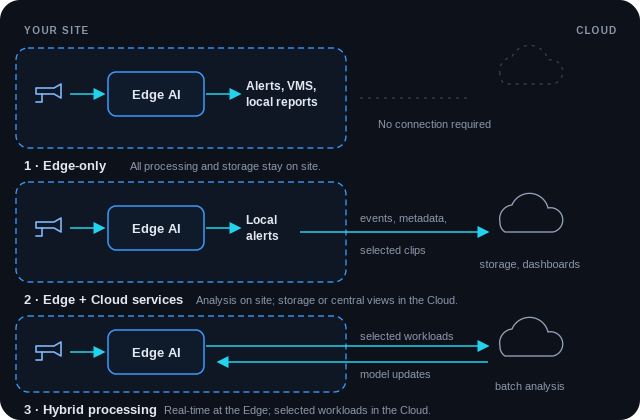
Two places to run the analysis
Every video analytics system has to decide where the AI models run. Edge processing analyzes video at or near the camera. Cloud processing sends video, or frames, to remote data centers for analysis. Industry sources broadly agree on the core trade-offs; the details depend on each project.
Comparing the two
| Factor | Edge | Cloud |
|---|---|---|
| Latency | Decisions on site, no round trip | Adds network delay |
| Connectivity | Works offline or with weak links | Needs dependable connectivity |
| Bandwidth | Sends events and metadata | Uploads video or frames |
| Privacy | Video can stay on site | Data leaves the site |
| Compute | Fixed by installed hardware | Elastic |
| Cost profile | Upfront hardware, predictable running cost | Usage-based, grows with volume |
| Operations | Devices to maintain on site | Central management |
When the edge is the better fit
- Alerts or decisions are needed within seconds, such as safety events or inspection rejects.
- Many cameras would make continuous uploads expensive.
- Sites are remote, mobile or have unreliable networks.
- Video must stay on site for privacy, security or regulatory reasons.
When the Cloud helps
- Recorded footage is analyzed in batches, with no real-time requirement.
- Very large models are needed on a small number of selected frames.
- Models are trained or evaluated on large data sets.
- Results from many sites are combined in central dashboards.
Why hybrid is common
Most organizations do not need to choose one exclusively. In a hybrid architecture, Edge devices handle real-time analysis and send events, metadata and selected clips to Cloud services for central reporting, storage and model improvement. The site keeps working if the Cloud connection drops.
A practical decision process
- Define how quickly results are needed and who acts on them.
- Check connectivity and bandwidth at each site.
- Clarify which data may leave the site, and where it may be stored.
- Estimate stream counts, resolution and model complexity.
- Compare total cost over the expected lifetime, not just year one.
Conclusion
For live video, Edge-first architectures usually offer the best balance of speed, bandwidth and data control. Cloud services earn their place when they add capabilities the edge cannot provide efficiently.