Fundamentals
What Is Edge AI Video Analytics?
Edge AI video analytics runs computer vision models on or near the cameras that capture the video, instead of sending all footage to a remote data center. This article explains how it works, why it matters and when it is the right choice.
EdgeTech editorial team ·
A simple definition
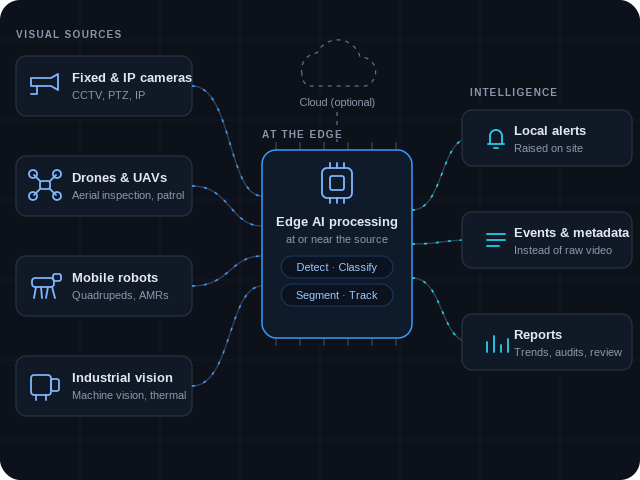
Edge AI video analytics means running computer vision models at or near the place where video is captured — on the camera itself, on a computer in the same building, or on compute carried by a drone, robot or vehicle. Instead of streaming every frame to a distant data center, the “edge” analyzes video locally and sends onward only what matters: alerts, events, counts and selected images.
How it works
A typical Edge AI video pipeline has five stages:
- Capture. A camera, drone, robot or other visual source produces video.
- Decode and preprocess. Frames are decoded, resized and sometimes cropped to the region of interest.
- Inference. One or more AI models — for example object detection or segmentation — interpret each frame.
- Logic. Tracking, zones and rules turn per-frame detections into events, such as “person entered restricted area” or “vehicle waited more than ten minutes”.
- Output. Events go to operators, dashboards or business systems. Raw video can stay on site.
All of this can run on hardware the size of a book, mounted in a cabinet or vehicle.
Why process video at the edge?
Latency. Decisions are made where events happen, without a round trip to a remote service. That matters for safety alerts, inspection rejects and operational responses.
Bandwidth. Video is heavy. Sending events instead of continuous streams reduces network load and transfer costs, particularly at sites with many cameras or limited connectivity.
Privacy and data control. Footage can stay on infrastructure the organization controls, which simplifies many privacy, security and data-residency requirements.
Resilience. Edge systems keep working when external networks are slow or unavailable — important for remote sites, vehicles and critical infrastructure.
Where Cloud still fits
Edge-first does not mean Edge-only. Cloud services are useful for multi-site dashboards, long-term storage of selected clips, fleet management and training improved models. In a well-designed hybrid system, the Edge handles time-critical analysis and the Cloud complements it.
What Edge AI video analytics is used for
Common applications include PPE compliance, workplace safety, quality inspection, people and vehicle counting, perimeter monitoring and equipment monitoring. The same building blocks — detection, tracking, segmentation, OCR — combine differently for each use case.
Limitations to plan for
Edge hardware has fixed capacity, so models, resolution and frame rates must be sized to it. Results depend heavily on camera placement, lighting and how closely training data matches the site. And on-site hardware needs power, protection and maintenance. These are engineering questions, best answered with real footage in a focused Proof of Concept (PoC).
Getting started
The most reliable way to judge whether Edge AI video analytics fits your problem is to test it on your own footage. Start with one well-defined question, a representative video clip and a clear description of the outcome you need.