Hardware & DeploymentEdge first, Cloud where it adds value
Hybrid Edge + Cloud Architecture
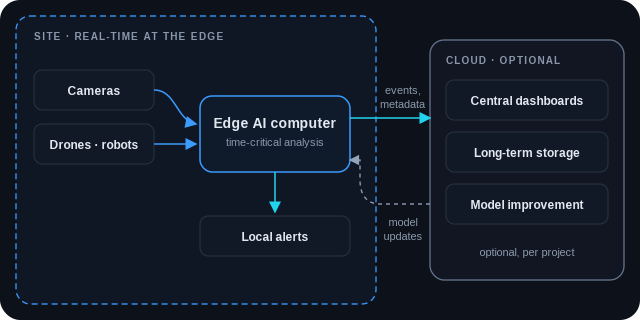
In a hybrid architecture, time-critical video analysis runs at the edge while selected functions — central dashboards, long-term storage, fleet management or model improvement — run in the Cloud. The Edge remains the core; the Cloud complements it.
Deployment arrangements
- Edge analysis, Cloud reporting. Edge devices analyze video locally and send events and metadata to Cloud dashboards spanning many sites.
- Edge analysis, Cloud storage. Selected clips or images are stored in the Cloud for audits or investigations, under agreed retention rules.
- Edge inference, Cloud training. Models run at the edge; selected, approved data supports retraining in the Cloud, with updated models deployed back.
Why hybrid
Local speed, central view
Alerts stay fast and local while managers see results across all sites.
Minimal data transfer
Only events, metadata and selected media cross the network.
Continuous improvement
Approved data can improve models over time without moving all video to the Cloud.
Edge at the core
In EdgeTech’s architectures, the Edge does the time-critical work: analyzing video and raising alerts on site. The Cloud is added for functions that genuinely benefit from centralization.
Designing the data flow
Hybrid designs specify exactly what leaves each site: events, metadata, thumbnails, clips or training data. Each flow has a purpose, a retention rule and an owner.
Resilience
A hybrid system must degrade gracefully. If the Cloud is unreachable, sites continue to operate and synchronize later.
Edge and Cloud: practical trade-offs
Neither option is better in every respect. The right balance depends on the latency, connectivity, data and cost requirements of the project.
| Factor | Processing at the Edge | Processing in the Cloud |
|---|---|---|
| Data leaving the site | Events and metadata only, by default. | Clips or images when explicitly agreed, with retention and access rules. |
| Central visibility | Per-site dashboards on the local network. | Multi-site dashboards and comparisons in one place. |
| Model lifecycle | Models run locally with fixed capacity. | Retraining and evaluation on larger data sets when needed. |
Limitations & scope
- Any data leaving the site requires agreement on storage location, access and retention.
- Cloud services add recurring costs that grow with data volume and usage.
- The site must keep functioning if the Cloud connection is lost; this is part of the design.
Proof of Concept
Have a visual AI challenge? Let's prove it.
Share a video of what happens in your environment and describe the outcome you need. We review every request for technical feasibility, then agree the scope of a focused Proof of Concept (PoC) with you.
Every request is reviewed for technical feasibility. PoC scope, timing and terms are agreed individually.
Frequently asked questions
Does hybrid mean video is streamed to the Cloud?
Not by default. Hybrid designs keep video analysis at the edge and send events and metadata. Media is sent only when explicitly agreed.
What happens if the internet connection drops?
Edge analysis and local alerts continue. Events are buffered and synchronized when the connection returns.
Related topics
How this page connects to industries, use cases, AI tasks, input sources and deployment options.