Architecture
Edge-Only vs Hybrid Edge + Cloud Architecture
Once video is analyzed at the edge, the next question is whether anything should go to the Cloud at all. This article compares Edge-only and hybrid Edge + Cloud architectures, the data flows involved and how to decide.
EdgeTech editorial team ·
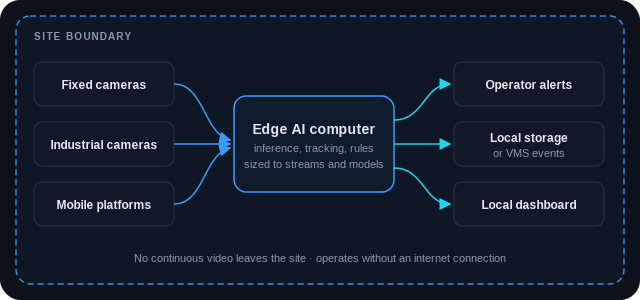
Two Edge-first patterns
Both architectures analyze video at the edge. The difference is what — if anything — leaves the site.
Edge-only. Analysis, alerts, storage and dashboards all stay within the site. Nothing depends on an external connection.
Hybrid Edge + Cloud. Analysis and alerts stay on site, while selected data — events, metadata, sometimes clips — flows to Cloud services for central dashboards, long-term storage, fleet management or model improvement.
When Edge-only is the right choice
- A single site, or sites managed independently.
- Strict rules that video and derived data must stay on premises.
- Unreliable or tightly controlled connectivity.
- Use cases that only need local alerts and reports.
When hybrid adds value
- Many sites need a single view of results.
- Selected footage must be retained centrally for audits or investigations.
- Models benefit from retraining on approved data from several sites.
- Devices are managed remotely as a fleet.
Designing the data flows
In a hybrid system, every data flow should have a purpose, an owner and a retention rule:
- Events and metadata — usually the default, small and low-risk.
- Thumbnails or short clips — only where agreed, with access controls.
- Training data — only approved, governed subsets.
- Management traffic — device health, configuration and updates.
Resilience
Hybrid systems must degrade gracefully. If the Cloud is unreachable, local analysis and alerts continue, and events are buffered and synchronized later.
Deciding
Start Edge-only unless there is a clear reason to centralize. Add Cloud services one capability at a time, each with a defined benefit and agreed data governance.