AI TaskDistance and 3D structure from cameras
Depth Estimation
Depth estimation recovers how far each part of a scene is from the camera, using stereo or depth sensors or learned monocular models. Depth turns flat detections into positions, volumes and distances that robots, measurement and safety awareness can use.
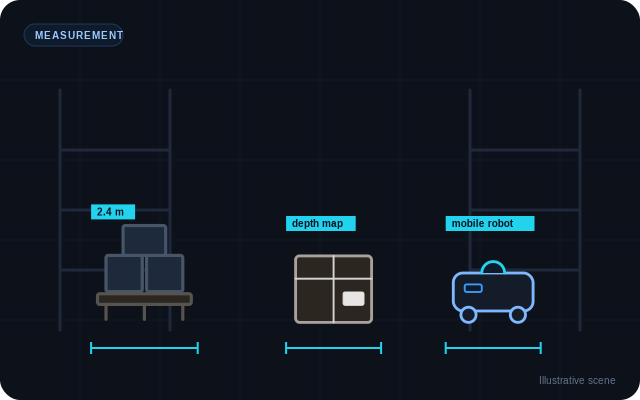
Definition
Depth estimation assigns a distance to pixels or objects. Active depth sensors and stereo cameras measure it geometrically; monocular models infer relative depth from a single image. Combined with detection or segmentation, depth yields 3D positions, sizes and volumes.
Typical outputs
- Depth maps or point clouds
- Distances to detected objects
- Volume and height estimates for piles, loads and stacks
Where it is used
Robot picking
Giving robots the 3D position of parts and cartons for grasping and depalletizing.
Volume and fill
Estimating stockpile, container and truck-load volumes.
Distance awareness
Estimating distances between people, vehicles and machinery as an awareness aid.
How it works
Stereo cameras compare two viewpoints to triangulate distance; time-of-flight and structured-light sensors measure it actively. Learned models can estimate relative depth from one image. The result is combined with detections to locate objects in 3D.
Choosing an approach
Where centimeters matter — robots, volumes, clearances — measured depth is the reliable choice. Monocular depth suits rough ordering of objects or enriching existing camera views.
Edge considerations
Depth processing often runs on the same Edge computer as detection. Point clouds are large, so only derived measurements are usually sent onward.
Running it at the edge
Model, resolution, frame rate and hardware are planned together for each project.
Design considerations
- Measured versus inferred. Stereo and depth sensors give metric distances; monocular models give relative depth unless calibrated.
- Compute load. Dense depth at high frame rates is demanding and is sized carefully against other models.
- Surfaces matter. Shiny, transparent or very dark surfaces disturb depth sensing.
Limitations & scope
- Monocular depth is relative and can be wrong in unusual scenes; it is not a substitute for measured depth where accuracy matters.
- Depth sensors have limited range and are affected by sunlight and surface properties.
- Distance estimates used for safety functions require certified sensors.
Proof of Concept
Have a visual AI challenge? Let's prove it.
Share a video of what happens in your environment and describe the outcome you need. We review every request for technical feasibility, then agree the scope of a focused Proof of Concept (PoC) with you.
Example request: “We want to estimate how full each outbound trailer is from a depth camera above the dock door.”
Every request is reviewed for technical feasibility. PoC scope, timing and terms are agreed individually.
Frequently asked questions
Do we need a special camera?
For metric accuracy, usually yes — a stereo or depth camera. Monocular models can add relative depth to existing cameras for less demanding uses.
How accurate are volume estimates?
That depends on sensor, distance and geometry. Accuracy is measured against reference measurements during a PoC.
Related topics
How this page connects to industries, use cases, AI tasks, input sources and deployment options.