AI TaskTurning detections into numbers
Counting and Measurement
Counting and measurement convert detections, tracks and masks into quantities — how many objects, how long they stayed, how big they are, how full an area is. They are the bridge between computer vision outputs and operational metrics.
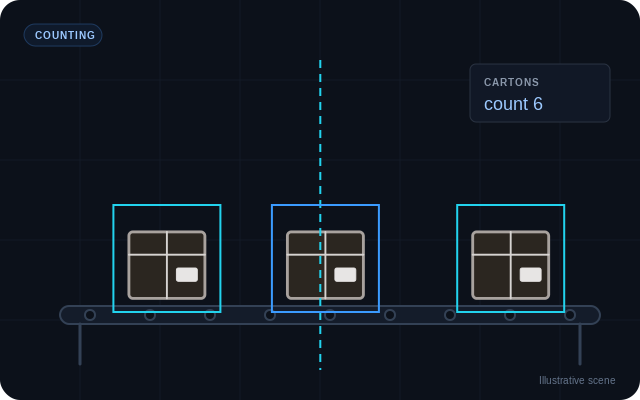
Definition
Counting aggregates detections or tracks into quantities, such as objects per zone or line crossings per interval. Measurement derives physical or temporal quantities — size, distance, area, fill level, dwell time — from detections, masks and tracks, often using camera calibration.
Typical outputs
- Counts per class, zone, line and time interval
- Dwell times and durations
- Size, area or fill estimates with stated uncertainty
Where it is used
Flow counting
People and vehicle counts for planning, staffing and capacity.
Stock and occupancy
Occupied locations, items on shelves and space utilization.
Size and fill estimates
Estimating object sizes, container fill levels or stockpile changes where geometry allows.
How it works
Counting logic sits on top of detection and tracking: objects crossing a line, present in a zone or detected per frame. Measurement uses masks, boxes and calibration to estimate sizes, distances and areas, and tracks to measure durations.
Defining the metric
Good counting projects start by defining exactly what is counted and when — a person crossing a door inward, a pallet occupying a slot for more than a minute — and how the result will be validated.
Edge considerations
Counting is computationally light once detection and tracking run. Aggregating on the Edge device means only small summaries leave the site.
Running it at the edge
Model, resolution, frame rate and hardware are planned together for each project.
Design considerations
- Calibration for real units. Converting pixels to centimeters or meters needs camera calibration and a known reference or geometry.
- Tracking prevents double counting. Counting moving objects relies on tracking so each object is counted once per crossing.
- Aggregation on the device. Counts can be aggregated on the Edge device and transmitted as small summaries.
Limitations & scope
- Counts are estimates; occlusion and crowding cause under- or over-counting.
- Measurement accuracy depends on calibration, perspective and resolution, and must be validated against reference measurements.
- Measurements used for billing, legal or safety decisions may require certified instruments.
Proof of Concept
Have a visual AI challenge? Let's prove it.
Share a video of what happens in your environment and describe the outcome you need. We review every request for technical feasibility, then agree the scope of a focused Proof of Concept (PoC) with you.
Every request is reviewed for technical feasibility. PoC scope, timing and terms are agreed individually.
Frequently asked questions
How accurate is video-based counting?
It depends on the scene, camera position and density. Accuracy is measured on footage from your site against manual reference counts during a PoC.
Can it measure real-world sizes?
With calibration and suitable camera geometry, yes, within an accuracy that is validated for the specific setup.
Related topics
How this page connects to industries, use cases, AI tasks, input sources and deployment options.
Industries
- Edge AI Video Intelligence for Agriculture
- Edge AI Video Intelligence for Animal Monitoring
- Edge AI Video Intelligence for Banking and Finance
- Edge AI Video Intelligence for Education Campuses
- Edge AI Video Intelligence for Environmental Monitoring
- Edge AI Video Intelligence for Facilities and Real Estate
- Edge AI Video Intelligence for Healthcare Facilities
- Edge AI Video Intelligence for Hospitality and Food Service
- Edge AI Video Intelligence for Logistics
- Edge AI Video Intelligence for Retail
- Edge AI Video Intelligence for Smart Cities
- Edge AI Video Intelligence for Telecommunications
- Edge AI Video Intelligence for Transportation and Rail
- Edge AI Video Intelligence for Warehousing
Use Cases
- Axle and Wagon Counting
- Bakery Product Inspection
- Crowd Density Estimation
- Cyclist and Micromobility Counting
- Dimensional Measurement from Images
- Egg Inspection and Counting
- Fastener and Rivet Inspection
- Fill Level Inspection
- Fish Counting and Aquaculture Observation
- Flood and Water Level Monitoring
- Fruit Counting and Yield Estimation
- Hand Hygiene Compliance Awareness
- Insect and Pest Trap Monitoring
- Inventory Monitoring
- Livestock Counting
- Meter and Gauge Reading
- Occupancy Monitoring
- Order Packing Verification
- Pallet Counting and Identification
- Parcel Detection and Counting
- Parking Monitoring
- Part and Component Counting
- People Counting
- Pill Counting
- Plant Growth Monitoring
- Plant Stand and Emergence Counting
- Produce Grading and Sorting
- Queue Monitoring
- Rebar and Pipe Counting
- Rock Fragmentation Analysis
- Stockpile Volume Estimation
- Store Traffic Heat Maps
- Surgical Instrument Tray Verification
- Tailgating Detection at Access Points
- Telecom Tower Inspection
- Thermal Equipment Monitoring
- Tire and Wheel Inspection
- Traffic Monitoring
- Transit Occupancy Monitoring
- Vehicle Counting and Classification
- Waste Bin and Bunker Fill Monitoring