Input SourceMobile visual platforms
Drones & UAVs
Drones capture visual data where fixed cameras cannot reach — long perimeters, large sites, tall structures and remote assets. EdgeTech designs video analytics for aerial footage, processed onboard, on a nearby Edge device or in a hybrid arrangement, depending on the platform.
Where processing can run
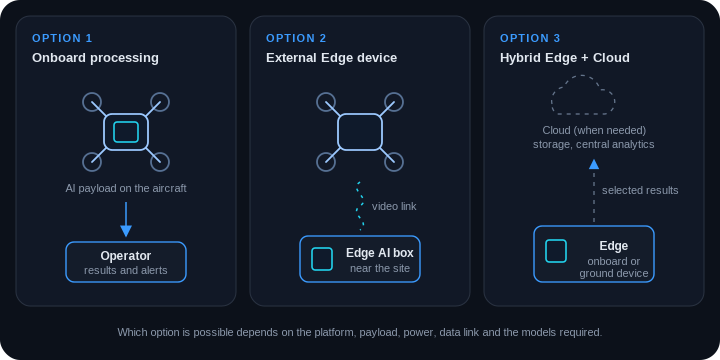
- Onboard processing. Models run on a compute payload carried by the aircraft, and results or alerts are sent to the operator. Only possible on platforms that support suitable onboard compute.
- External Edge device. The drone streams video to an Edge AI computer near the site, such as a ground station or vehicle-mounted unit, which runs the models.
- Hybrid Edge + Cloud. Real-time analysis happens at the edge, while selected results, clips or mission data go to Cloud services for storage and central analysis.
- Post-mission analysis. Recorded footage is analyzed after the flight on Edge or Cloud infrastructure, when real-time results are not required.
What this source enables
Inspection
Examine structures, roofs, pipelines, solar fields and other assets that are slow, costly or unsafe to inspect from the ground.
Monitoring and patrol
Cover long perimeters and large areas with repeatable flight routes, complementing fixed cameras rather than replacing them.
Situational awareness
Provide an aerial view of a site, incident or operation, with analytics highlighting objects and changes that matter.
Remote visual analysis
Reach remote or hazardous locations without sending people, and analyze the footage onboard, nearby or after the mission.
Drones as mobile visual sources
A drone is a visual input source: it captures images and video. It may also carry a compute payload, but the aircraft and its computer are separate parts of the architecture. Treating them separately makes it clear what each platform can actually do — and avoids assuming that every drone can run AI models in flight.
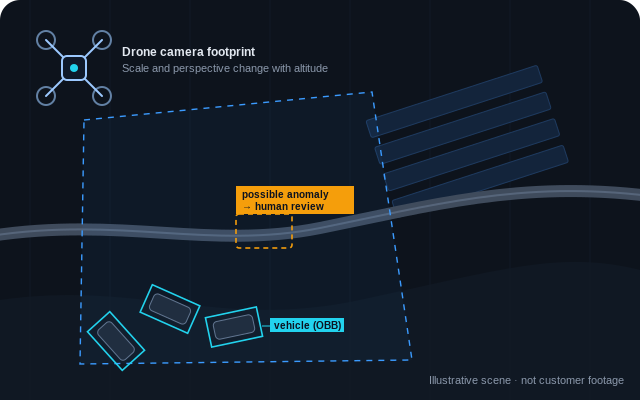
Aerial footage is valuable precisely because it differs from fixed-camera video: wide coverage, changing viewpoints, and access to places no fixed camera can see. Those same properties make it harder to analyze, so aerial use cases are evaluated on footage from real missions.
Choosing where processing runs
The right option depends on what the mission needs. If a pilot needs results while flying, processing must happen onboard or on an Edge device within range of the video link. If the goal is a report after an inspection, post-mission analysis is simpler and allows larger models. Many projects combine both.
Hardware and compatibility
Compatibility statements on this page are limited to what manufacturers document officially, and are listed below with their sources. A product listed here does not imply a partnership with EdgeTech or an integration EdgeTech has already completed; each integration is verified for the specific project.
What to consider
Practical factors that determine which architecture and models are feasible.
Platform and mission
- Altitude, scale and viewpoint. Objects look very different from above and change size with altitude. Models are evaluated on footage captured at your typical flight heights and angles.
- Motion and stability. A moving platform introduces motion blur, vibration and changing backgrounds, which affect detection and tracking.
- Data link and bandwidth. Live analysis on the ground depends on the video link. Range, interference and compression all influence what reaches the Edge device.
- Payload, power and weight. Onboard compute adds weight and draws power, which affects flight time. Not every aircraft offers a compute payload option.
- Flight operations and regulation. Airspace permissions, pilot responsibilities and local drone regulation remain with the operator and shape what missions are possible.
- Live or post-mission. Some needs are met by analyzing recorded footage after landing, which is simpler and less dependent on onboard compute or links.
Hardware references and compatibility status
Statements are limited to what manufacturers document officially. Listing a product does not imply a partnership with EdgeTech or a completed integration; compatibility is verified for each project.
| Platform | What the manufacturer states | Status | Source |
|---|---|---|---|
| DJI Manifold 3 | Onboard computing payload rated at up to 100 TOPS, using GPU and DLA components to run and accelerate algorithm models; weighs about 120 g.Note: DJI's product page does not name the underlying compute module. Model-level performance on Manifold 3 must be measured per project. | Officially verified | Official pageChecked 2026-11-21 |
| DJI Manifold 3 | Designed to be mounted on the DJI Matrice 400 and Matrice 4 Series drone platforms.Note: Support for other airframes, the Matrice 4D Series or dock-based operation was not confirmed on the official page and must be checked with DJI. | Officially verified | Official pageChecked 2026-11-21 |
Limitations & scope
- Not every drone can run AI models onboard. Onboard processing depends on the aircraft's payload options, power budget, software access and the size of the models.
- Detection performance on aerial footage must be validated separately; models trained on ground-level images do not transfer reliably to top-down views.
- Flight operations, airspace permissions and pilot responsibilities remain with the operator.
Proof of Concept
Have a visual AI challenge? Let's prove it.
Share a video of what happens in your environment and describe the outcome you need. We review every request for technical feasibility, then agree the scope of a focused Proof of Concept (PoC) with you.
Every request is reviewed for technical feasibility. PoC scope, timing and terms are agreed individually.
Frequently asked questions
Do all drones include an AI computer?
No. Some enterprise platforms offer an optional onboard compute payload — for example, DJI documents its Manifold 3 for the Matrice 400 and Matrice 4 Series. Many other drones need an external Edge device or post-mission processing.
Do you require a specific drone brand?
No. The architecture is designed around the platform you use or plan to use. Compatibility with a specific aircraft, payload or software interface is verified during project assessment.
Can analysis happen during the flight?
Sometimes. It requires either suitable onboard compute or a reliable video link to an Edge device nearby. When neither is practical, post-mission analysis is often the better choice.
Related topics
How this page connects to industries, use cases, AI tasks, input sources and deployment options.
Industries
- Edge AI Video Intelligence for Aerospace
- Edge AI Video Intelligence for Agriculture
- Edge AI Video Intelligence for Animal Monitoring
- Edge AI Video Intelligence for Construction
- Edge AI Video Intelligence for Energy
- Edge AI Video Intelligence for Environmental Monitoring
- Edge AI Video Intelligence for Infrastructure
- Edge AI Video Intelligence for Manufacturing
- Edge AI Video Intelligence for Mining
- Edge AI Video Intelligence for Oil and Gas
- Edge AI Video Intelligence for Telecommunications
- Edge AI Video Intelligence for Utilities
Use Cases
- Aerial Mapping and Feature Extraction
- Aircraft Surface Inspection
- Bridge and Tunnel Inspection Support
- Construction Progress Monitoring
- Container Damage Inspection
- Corrosion Detection
- Crack Detection on Concrete and Structures
- Crop Disease Symptom Detection
- Crowd Density Estimation
- Drone-Based Inventory Scanning
- Fire and Smoke Detection
- Fruit Counting and Yield Estimation
- Heavy Equipment Utilization Tracking
- Industrial Visual Inspection
- Livestock Counting
- Oil Sheen and Spill Detection on Water
- Pallet Counting and Identification
- Perimeter Monitoring and Intrusion Detection
- Pipeline Right-of-Way Monitoring
- Plant Stand and Emergence Counting
- Power Line Inspection
- Rock Fragmentation Analysis
- Solar Panel Inspection
- Stockpile Volume Estimation
- Telecom Tower Inspection
- Vegetation Encroachment Monitoring
- Weed Detection for Targeted Treatment
- Wildlife Monitoring
- Wind Turbine Blade Inspection
- Working at Height Safety Awareness