Input SourceCameras on robot arms and cells
Robotic Vision
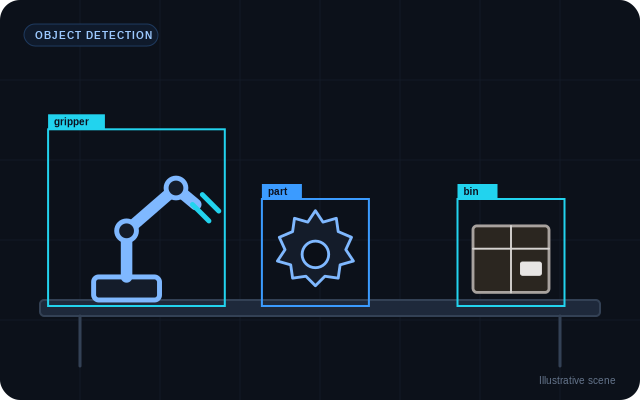
Robotic vision places cameras on or around robot arms to guide picking, placement, assembly and inspection. Edge AI adds the ability to handle variable parts, cluttered bins and visual checks within the robot cell.
Where processing can run
- Edge AI computer in the cell. An industrial computer with GPU or accelerator processes images and sends results to the robot controller.
- Smart camera. Simpler tasks can run on smart cameras with onboard compute where supported.
What this source enables
Picking variable parts
Locating parts in varied positions, including mixed or cluttered bins.
Assembly verification
Checking that the robot has placed or assembled components correctly.
In-cell inspection
Inspecting parts while the robot presents them to the camera.
Vision inside the robot cell
Industrial robots are precise but blind without vision. Cameras let them adapt to where parts actually are and check their own work. Edge AI extends this to variable parts and complex scenes.
Integration is the core
Robotic vision projects succeed on calibration and controller integration as much as on the model. These are planned together from the start.
Edge processing in the cell
Processing must keep pace with the robot, so vision runs on industrial Edge hardware inside or next to the cell.
What to consider
Practical factors that determine which architecture and models are feasible.
Platform and mission
- Camera placement. Cameras can be mounted on the robot wrist (eye-in-hand) or fixed above the cell (eye-to-hand); each suits different tasks.
- Calibration. Hand-eye calibration links camera coordinates to robot coordinates for accurate picking and placement.
- Cycle time. Vision processing must fit within the robot's cycle time, which constrains model size.
- Integration with the controller. Results must be passed to the robot controller through supported interfaces.
Limitations & scope
- Robot motion control and safety functions remain with the robot controller and certified safety systems.
- Calibration and integration effort is substantial and planned per cell.
- Transparent, reflective or deformable objects remain challenging for vision-guided picking.
Proof of Concept
Have a visual AI challenge? Let's prove it.
Share a video of what happens in your environment and describe the outcome you need. We review every request for technical feasibility, then agree the scope of a focused Proof of Concept (PoC) with you.
Example request: “We want a robot to pick mixed parts from a bin; can vision locate them reliably from our sample images?”
Every request is reviewed for technical feasibility. PoC scope, timing and terms are agreed individually.
Frequently asked questions
Is robotic vision the same as mobile robots?
No. Robotic vision here means cameras on or around fixed robot arms. Mobile robots move through facilities and are covered on their own page.
Can AI handle randomly placed parts?
Often, with suitable cameras, depth sensing and training data. Feasibility depends on part variety and presentation.
Related topics
How this page connects to industries, use cases, AI tasks, input sources and deployment options.
Industries
Use Cases
- Bridge and Tunnel Inspection Support
- Casting Defect Detection
- Corrosion Detection
- Crack Detection on Concrete and Structures
- Depalletizing Guidance
- Engine Borescope Inspection Support
- Object Pose Estimation for Robotics
- Part Orientation Detection
- Pick-and-Place Guidance
- Robotic Visual Inspection
- Sewer and Pipe Inspection
- Vision-Guided Bin Picking
- Weld Seam Inspection