AI TaskCore computer vision task
Instance Segmentation
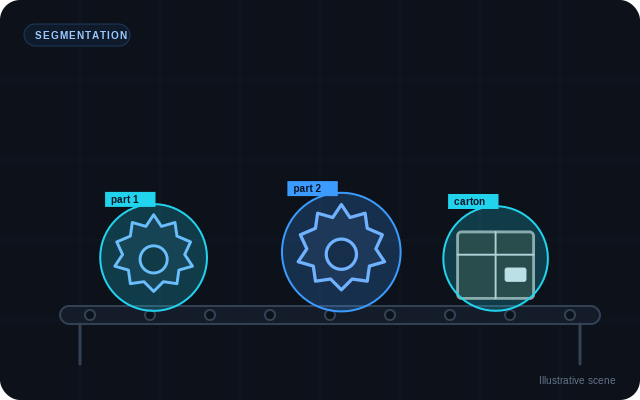
Instance segmentation detects each object and outlines its exact pixels — a separate mask per object. It combines the "which object" of detection with the "exact shape" of segmentation, for measurement and precise inspection.
Definition
Instance segmentation predicts, for every object of interest, a class label, a confidence score and a pixel-level mask that separates it from the background and from other objects of the same class.
Typical outputs
- A mask per object instance
- Class label and confidence per instance
- Derived measures such as area, shape and orientation
Where it is used
Measurement
Estimating the size, area or shape of individual objects such as parts, produce or defects.
Precise inspection
Outlining defect regions exactly for quality decisions and reporting.
Separating touching objects
Distinguishing objects that touch or overlap, such as items on a conveyor.
How it works
An instance segmentation model first finds candidate objects, as a detector does, and then predicts a mask for each. Some newer architectures predict instances and masks jointly. The result is a list of objects, each with its own outline.
Choosing between detection and segmentation
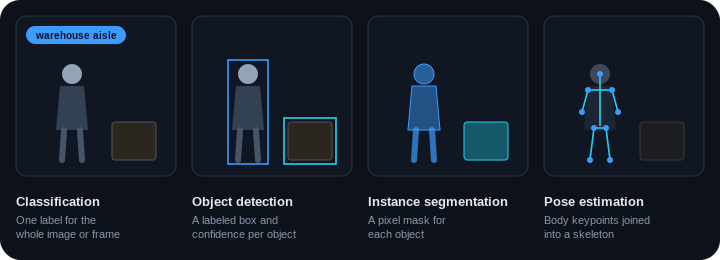
Detection gives boxes; instance segmentation gives exact shapes. If the question is “is it there?” or “how many?”, detection is usually enough. If it is “how big?”, “what shape?” or “exactly where is the defect?”, instance segmentation earns its extra cost.
Edge considerations
Instance segmentation can run on Edge GPUs and accelerators, but model choice, input resolution and the expected number of objects per frame are planned together.
Running it at the edge
Model, resolution, frame rate and hardware are planned together for each project.
Design considerations
- More compute than detection. Mask prediction adds compute per object; the number of objects per frame affects processing time.
- Mask resolution. Coarser masks are faster; fine measurement needs higher-resolution masks and inputs.
- Use where shape matters. If a bounding box answers the question, detection is cheaper and easier to deploy.
Limitations & scope
- Mask-level training data takes more effort to create than bounding boxes.
- Heavy overlap and transparent or reflective objects remain difficult.
- Measurements from images need camera calibration to convert pixels to real units.
Proof of Concept
Have a visual AI challenge? Let's prove it.
Share a video of what happens in your environment and describe the outcome you need. We review every request for technical feasibility, then agree the scope of a focused Proof of Concept (PoC) with you.
Every request is reviewed for technical feasibility. PoC scope, timing and terms are agreed individually.
Frequently asked questions
Do I need instance segmentation for counting?
Usually not. Detection is enough for counting. Instance segmentation helps when objects touch heavily or when size and shape are needed.
Can it measure real-world size?
Yes, with camera calibration and a known working distance or reference, pixel measurements can be converted to real units within a validated accuracy.
Related topics
How this page connects to industries, use cases, AI tasks, input sources and deployment options.