AI TaskFinding images and items that look alike
Visual Similarity Search
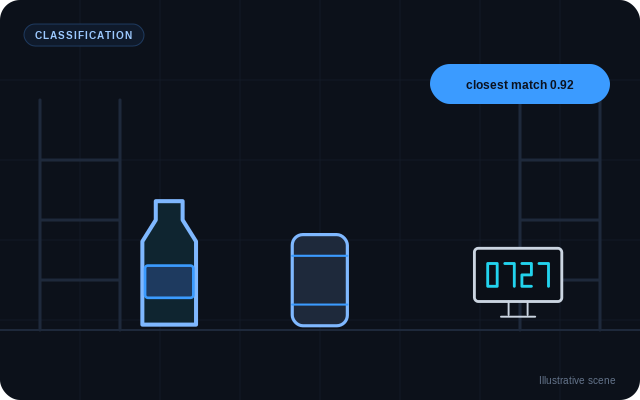
Visual similarity search turns images or detected objects into numeric embeddings and compares them, so a system can find the closest match in a reference catalog, group similar items, or recognize products and parts that were never part of a fixed class list.
Definition
An embedding model maps an image or crop to a vector so that visually similar items lie close together. Matching then becomes a nearest-neighbour search against stored reference vectors. New items can be added by adding reference images rather than retraining a classifier.
Typical outputs
- Closest catalog matches with similarity scores
- Clusters of visually similar images or items
- Unknown-item flags when no reference is close enough
Where it is used
Product and SKU recognition
Recognizing many products in vending, retail and packing where classes change frequently.
Part identification
Matching a part photographed at a workstation to the closest item in a parts catalog.
Finding similar events
Searching recorded footage for scenes that look like a known example, as an aid for review.
How it works
An embedding model converts each image or detected crop into a vector. Reference vectors for known items are stored in an index. At run time, the closest references are retrieved and their similarity scores decide whether the item is recognized, uncertain or unknown.
Classification or similarity?
Classification works well for a stable, limited set of classes. Similarity search suits large or frequently changing catalogs, because new items can be added without retraining the whole model.
Edge considerations
Embedding models and moderate catalogs run well on Edge accelerators. Very large catalogs may use a hybrid design where the index is updated centrally and synchronized to sites.
Running it at the edge
Model, resolution, frame rate and hardware are planned together for each project.
Design considerations
- Catalog size. Large reference catalogs need efficient indexes; smaller catalogs fit comfortably on an Edge device.
- Update without retraining. Adding a new product often means adding reference images, which simplifies changeovers.
- Threshold tuning. Similarity thresholds decide when a match is trusted; they are tuned on the customer's own items.
Limitations & scope
- Visually identical products, such as size variants with the same packaging, cannot be separated by appearance alone.
- Similarity scores are relative; thresholds must be validated per catalog.
- Embeddings of people are not used for identification in EdgeTech projects.
Proof of Concept
Have a visual AI challenge? Let's prove it.
Share a video of what happens in your environment and describe the outcome you need. We review every request for technical feasibility, then agree the scope of a focused Proof of Concept (PoC) with you.
Example request: “We want to recognize which of our 900 spare parts a technician is holding from a photo at the counter.”
Every request is reviewed for technical feasibility. PoC scope, timing and terms are agreed individually.
Frequently asked questions
Do we need to retrain for every new product?
Often not. Adding reference images to the catalog can be enough, but accuracy should be checked whenever the catalog changes significantly.
Can it work together with detection?
Yes. A detector finds items, and similarity search identifies each crop against the catalog.
Related topics
How this page connects to industries, use cases, AI tasks, input sources and deployment options.