Hardware & DeploymentAlternatives and complements to Jetson
Edge AI Accelerators and Embedded GPUs
Beyond NVIDIA Jetson, Edge AI workloads can run on embedded GPUs, discrete GPUs in industrial PCs, neural processing units (NPUs) and dedicated AI accelerator modules. Each class offers different trade-offs in performance, power, cost and software support.
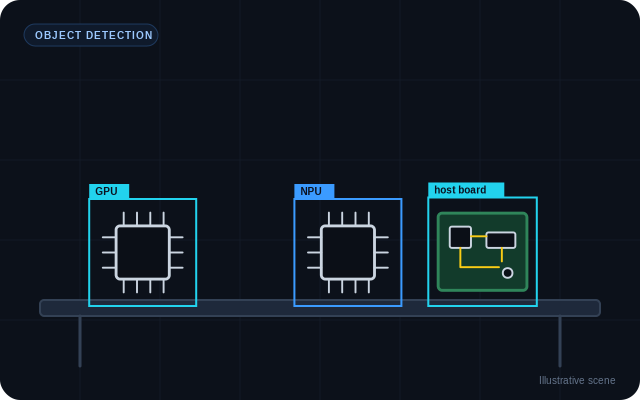
Deployment arrangements
- Discrete GPU in an industrial PC. High throughput for many streams or large models, at higher power and cost.
- Integrated NPU or embedded GPU. Processors with built-in AI acceleration for compact, lower-power systems.
- Accelerator modules. Add-on AI accelerator cards or modules that increase inference capacity of an existing host computer.
Selection factors
Model compatibility
The accelerator's software toolchain must support the model architecture and operators you plan to use.
Power and thermal budget
Low-power accelerators suit fanless and battery-powered devices; GPUs suit cabinets and server rooms.
Throughput and latency
The number of streams, resolution and frame rate determine the required inference capacity.
Many ways to accelerate inference
AI inference can be accelerated by GPUs, NPUs, dedicated accelerator chips and, for light models, modern CPUs. Each has strengths: GPUs for flexibility and throughput, NPUs for efficiency, accelerator modules for adding capacity to existing hosts.
The software stack matters as much as the chip
A fast accelerator is only useful if its toolchain supports the required models efficiently. Model selection and hardware selection are therefore done together.
Avoiding lock-in
Choosing model architectures and frameworks with broad hardware support keeps future options open as hardware evolves.
Limitations & scope
- Converting and optimizing models for a specific accelerator can require significant engineering effort.
- Published performance figures from vendors are not directly comparable across precisions and benchmarks; measurement with your models is required.
- No accelerator is universally best; the choice is project-specific.
Proof of Concept
Have a visual AI challenge? Let's prove it.
Share a video of what happens in your environment and describe the outcome you need. We review every request for technical feasibility, then agree the scope of a focused Proof of Concept (PoC) with you.
Every request is reviewed for technical feasibility. PoC scope, timing and terms are agreed individually.
Frequently asked questions
Is a GPU always required for Edge AI?
No. Lightweight models can run on CPUs or small NPUs. GPUs or larger accelerators are needed as model complexity and stream counts grow.
Can models move between accelerators?
Often, with conversion steps, but operator support and performance differ. Portability is considered when choosing models and hardware.
Related topics
How this page connects to industries, use cases, AI tasks, input sources and deployment options.