Use CaseBags and items left in public spaces
Unattended Object Detection
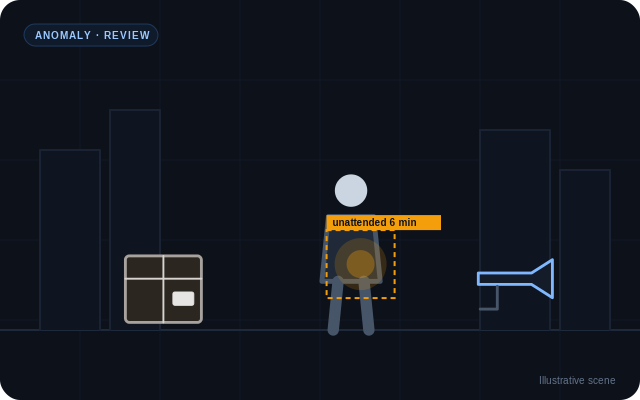
Detect bags or objects left unattended in stations, terminals and public buildings beyond a defined time, so staff can check them.
What can be checked
- Objects left stationary
- Time unattended
- Location in the scene
What the team receives
- Alerts with snapshot and duration
- Event log
What the solution does
Security awareness
Flags bags, cases and other items left unattended beyond a set time so staff can check them before they become a disruption.
Configurable thresholds
Sets time thresholds per area, from busy concourses to quiet corridors.
Works with existing CCTV
Can often run on existing CCTV views, subject to a camera review of angle, resolution and lighting during the PoC.
The operational problem
Unattended items in public spaces must be checked quickly, but staff cannot watch every camera.
How visual intelligence helps
Analytics detect objects that remain stationary without a nearby owner beyond a defined time and alert staff with snapshots.
Example visual workflow
- Cameras observe public areas.
- New stationary objects are detected.
- Objects unattended beyond a threshold trigger alerts.
- Staff verify.
Illustrative workflow — the actual pipeline is designed for each site during the PoC.
Edge deployment considerations
Edge servers in the station or terminal process video locally and send only alerts to the security control room.
How the solution is built
AI capabilities
The AI tasks this use case combines.
- Object Tracking and Multi-Object Tracking
Object tracking links detections of the same object across consecutive video frames and assigns each one a persistent ID.
- Visual Anomaly Detection
Visual anomaly detection learns what normal looks like and flags images, regions or events that deviate from it.
Visual inputs
Cameras and imaging that typically supply the video.
- CCTV and Existing Surveillance Systems
Many sites already run CCTV systems — analog cameras, DVRs, NVRs and video management systems.
- IP and Network Cameras
IP cameras stream digital video over standard networks and are the most common source for Edge AI video analytics.
Deployment options
General approaches to evaluate, not tested hardware. Specific hardware is selected and validated for each project during the PoC.
- Camera and VMS Integration
Most projects start with cameras that are already installed.
- Edge AI Hardware Sizing
Sizing Edge AI hardware means matching compute, memory, power and enclosure to the real workload — the number of streams, resolution, frame rate, models and latency targets — under the site's environmental and installation constraints.
- Edge Deployment Architectures
Edge-first means processing video at or near where it is captured.
Practical factors to plan for
Real-world results depend as much on the environment and camera setup as on the model.
Site and setup
- Busy scenes. Crowds and occlusion cause false alerts.
- Time thresholds. Thresholds must suit the environment.
Human review
Staff verify every alert and follow established security procedures.
Limitations & scope
- Busy environments produce more false alerts.
- Does not assess what the object is.
Proof of Concept
Have a visual AI challenge? Let's prove it.
Share a video of what happens in your environment and describe the outcome you need. We review every request for technical feasibility, then agree the scope of a focused Proof of Concept (PoC) with you.
Example request: “We want alerts for bags left unattended for more than five minutes in our station concourse.”
Every request is reviewed for technical feasibility. PoC scope, timing and terms are agreed individually.
Related topics
How this page connects to industries, use cases, AI tasks, input sources and deployment options.