IndustryUrban mobility and public services
Edge AI Video Intelligence for Smart Cities
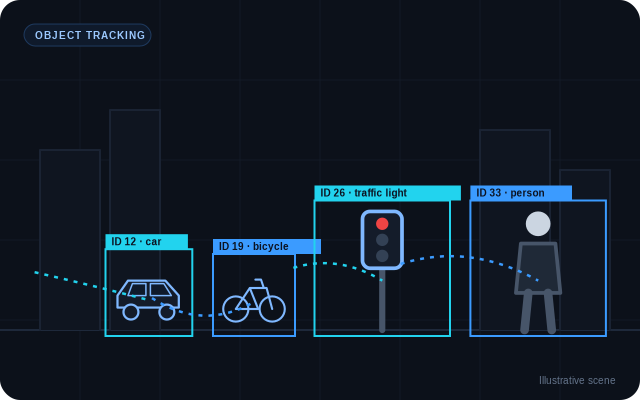
Cities use cameras for traffic, parking, public spaces and services. Edge AI video intelligence can turn that footage into anonymous, aggregate information — traffic counts, parking occupancy, crowding and incidents — processed close to the camera to respect privacy.
Common challenges
- Traffic and parking demand change constantly and are measured only in spots.
- Public spaces must be kept safe without excessive surveillance.
- Streaming video from thousands of cameras to a central system is costly.
- Public trust depends on transparent, privacy-respecting use of video.
Typical visual sources
- Fixed and PTZ cameras at junctions, streets and public spaces
- Cameras on buses, service and enforcement vehicles
- Cameras in car parks and transport hubs
Potential applications
Traffic counting and classification
Count vehicles, cyclists and pedestrians by class and direction to inform planning and signal timing.
Parking occupancy
Estimate free and occupied spaces in streets and car parks to guide drivers and enforcement.
Public-space occupancy
Measure anonymous crowding levels at squares, stations and events.
Incident and obstruction awareness
Detect stopped vehicles, debris or blocked lanes to support operators.
Information, not identities
The most defensible smart-city applications produce aggregate information: how many vehicles use a junction, how full a car park is, how crowded a square becomes. Designing for these outputs, and not for tracking individuals, keeps projects aligned with public expectations.
Why Edge processing is central
Sending continuous video from many cameras to a data center is expensive and raises privacy concerns. Processing at or near the camera sends only results, reduces bandwidth and allows raw footage to be discarded early.
Questions to answer early
- Which mobility or service decision will the data support?
- What legal basis, transparency and retention rules apply?
- Which existing city platforms must receive the results?
Limitations & scope
- Public-space analytics require a clear legal basis, transparency and privacy impact assessment.
- Face recognition and individual identification are outside the scope of these solutions.
- City-scale rollouts require integration with existing traffic and city platforms, planned per program.
Proof of Concept
Have a visual AI challenge? Let's prove it.
Share a video of what happens in your environment and describe the outcome you need. We review every request for technical feasibility, then agree the scope of a focused Proof of Concept (PoC) with you.
Example request: “We want to count vehicles, cyclists and pedestrians crossing a junction by direction, every 15 minutes.”
Every request is reviewed for technical feasibility. PoC scope, timing and terms are agreed individually.
Frequently asked questions
Does processing at the edge help with privacy?
Yes. Analyzing video at the camera or in a nearby cabinet means only anonymous counts and events need to leave the site, and raw footage can be discarded after analysis where policy allows.
Can existing traffic cameras be reused?
Often, if their position and resolution suit the task. An assessment of a sample of camera views confirms which can be reused.
Related topics
How this page connects to industries, use cases, AI tasks, input sources and deployment options.
Use Cases
- Crowd Density Estimation
- Cyclist and Micromobility Counting
- Flood and Water Level Monitoring
- Graffiti and Vandalism Detection
- Illegal Parking Detection
- Litter and Illegal Dumping Detection
- Occupancy Monitoring
- Parking Monitoring
- Pedestrian Crossing Safety Analytics
- People Counting
- Platform Edge Safety Awareness
- Pothole and Road Damage Detection
- Sewer and Pipe Inspection
- Streetlight Outage Detection
- Traffic Monitoring
- Traffic Sign and Road Asset Inventory
- Transit Occupancy Monitoring
- Unattended Object Detection
- Vehicle Counting and Classification
- Vehicle Speed Estimation for Traffic Studies
- Video Anonymization and Privacy Redaction
- Waste Bin and Bunker Fill Monitoring
- Wrong-Way Driving Detection