Use CaseBody movement from training video
Athlete Pose and Technique Analysis
Estimate body keypoints from training video to analyze technique — joint angles, posture and timing — without markers or wearables.
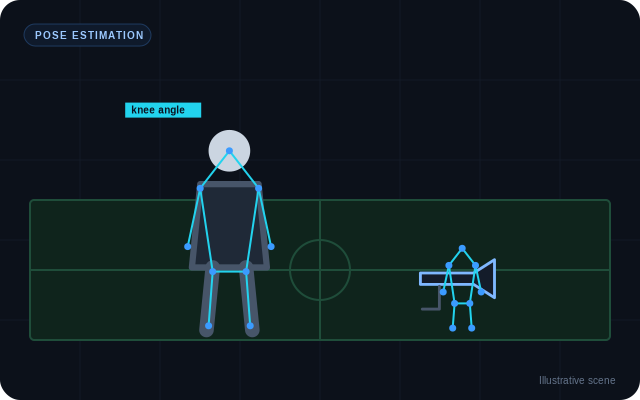
What can be checked
- Body keypoints
- Joint angles
- Movement phases
What the team receives
- Annotated video
- Angle and timing measurements
What the solution does
Markerless
Measures movement from video without markers or wearable sensors on the athlete.
Objective measures
Turns technique into joint angles and timings that can be compared between sessions.
Quick feedback
Processes recordings on site, so coaches can review joint angles and timings during the same session instead of days later.
The operational problem
Technique analysis typically relies on coaches’ eyes or expensive marker-based motion capture, which is not practical for everyday training.
How visual intelligence helps
Pose estimation extracts body keypoints from training video and calculates joint angles and movement phases. Coaches review annotated clips and measurements alongside their own observations.
Example visual workflow
- A camera records the movement.
- Keypoints are estimated per frame.
- Angles and phases are calculated.
- Coaches review annotated video.
Illustrative workflow — the actual pipeline is designed for each site during the PoC.
Edge deployment considerations
A local Edge computer or laptop processes video right after recording, so feedback is available during the same session.
How the solution is built
AI capabilities
The AI tasks this use case combines.
- Pose Estimation
Pose estimation locates keypoints — such as shoulders, elbows, knees or the corners of an object — and connects them into a skeleton or structure.
Visual inputs
Cameras and imaging that typically supply the video.
- High-Speed Cameras
High-speed cameras capture hundreds or thousands of frames per second, revealing events too fast for standard cameras — on fast packaging lines, in machinery or in process analysis.
- IP and Network Cameras
IP cameras stream digital video over standard networks and are the most common source for Edge AI video analytics.
- Mobile Device Cameras
Smartphones and tablets put capable cameras and processors in the hands of field teams.
Deployment options
General approaches to evaluate, not tested hardware. Specific hardware is selected and validated for each project during the PoC.
- Camera and VMS Integration
Most projects start with cameras that are already installed.
- Edge AI Hardware Sizing
Sizing Edge AI hardware means matching compute, memory, power and enclosure to the real workload — the number of streams, resolution, frame rate, models and latency targets — under the site's environmental and installation constraints.
- Edge Deployment Architectures
Edge-first means processing video at or near where it is captured.
- Industrial and Ruggedized Edge AI Computers
Industrial Edge AI computers and ruggedized systems house AI-capable processors in enclosures built for factories, vehicles and outdoor sites — wide temperature ranges, vibration, dust and industrial power.
- Standalone Edge AI Devices
Standalone Edge AI devices are compact, self-contained units — AI boxes or smart cameras — that process video locally at a single location.
Practical factors to plan for
Real-world results depend as much on the environment and camera setup as on the model.
Site and setup
- Camera angle. Measurements depend on viewpoint.
- Frame rate. Fast movements need high frame rates.
Human review
Coaches interpret results. Analysis is not a medical assessment.
Limitations & scope
- 2D views limit 3D accuracy.
- Not a substitute for clinical gait analysis.
Proof of Concept
Have a visual AI challenge? Let's prove it.
Share a video of what happens in your environment and describe the outcome you need. We review every request for technical feasibility, then agree the scope of a focused Proof of Concept (PoC) with you.
Example request: “We want knee and hip angles of sprinters during block starts from a side camera.”
Every request is reviewed for technical feasibility. PoC scope, timing and terms are agreed individually.
Related topics
How this page connects to industries, use cases, AI tasks, input sources and deployment options.