Input SourceFast processes and short events
High-Speed Cameras
High-speed cameras capture hundreds or thousands of frames per second, revealing events too fast for standard cameras — on fast packaging lines, in machinery or in process analysis. They generate very large data volumes, which shapes how Edge AI is applied.
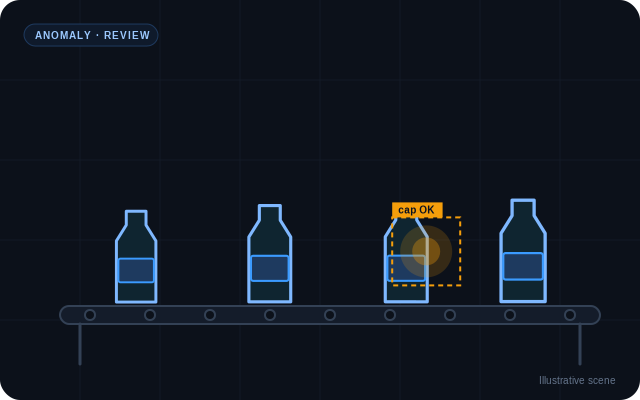
Where processing can run
- Triggered burst analysis. The camera records bursts around triggers; an Edge computer analyzes the buffered frames shortly after.
- Region-of-interest processing. Analyzing only a small region of each frame reduces compute enough for some inline uses.
- Offline analysis. Recorded sequences are analyzed after capture for engineering investigations.
What this source enables
Fast packaging inspection
Sharp images of products moving at high line speeds for inspection and verification.
Machine event analysis
Visualizing jams, misfeeds and mechanical events that happen in milliseconds.
Process studies
Analyzing fast processes such as filling, cutting or sealing for engineering optimization.
Seeing the very fast
Some problems happen too quickly for standard cameras: a misfeed, a splash, a bounce. High-speed cameras make these events visible, and Edge AI can help find the relevant moments in large volumes of frames.
Architecture follows data volume
Because high-speed cameras generate so much data, architectures typically capture around triggers and process selectively. This keeps Edge hardware requirements realistic.
Choosing the right camera
The first question is whether the problem needs high frame rates or simply short exposures. Many inspection tasks on fast lines can be handled with triggered industrial cameras.
What to consider
Practical factors that determine which architecture and models are feasible.
Platform and mission
- Data volume. Very high frame rates produce enormous data rates; analyzing every frame in real time is often impractical, so capture is triggered or buffered.
- Lighting. Short exposure times need intense, flicker-free lighting to produce usable images.
- Triggered capture. Many applications capture short bursts around an event rather than streaming continuously.
Limitations & scope
- Real-time analysis of every high-speed frame is rarely feasible; designs rely on triggering or region-of-interest processing.
- High-speed imaging needs specialized lighting and often specialized interfaces.
- Storage and transfer of high-speed footage must be planned carefully.
Proof of Concept
Have a visual AI challenge? Let's prove it.
Share a video of what happens in your environment and describe the outcome you need. We review every request for technical feasibility, then agree the scope of a focused Proof of Concept (PoC) with you.
Example request: “We want to understand why cartons occasionally misfeed at our high-speed erector, from slow-motion footage.”
Every request is reviewed for technical feasibility. PoC scope, timing and terms are agreed individually.
Frequently asked questions
Do we need a high-speed camera for a fast line?
Not always. Short exposure with a standard industrial camera may capture moving parts sharply enough. High frame rates are needed when the event itself is very short.
Can high-speed footage be analyzed live?
Partially. Triggered bursts and region-of-interest analysis allow near-real-time results for specific events.
Related topics
How this page connects to industries, use cases, AI tasks, input sources and deployment options.
Industries
Use Cases
- Athlete Pose and Technique Analysis
- Axle and Wagon Counting
- Ball Tracking
- Conveyor Belt Monitoring
- Fabric Defect Detection
- Fill Level Inspection
- Glass and Bottle Defect Inspection
- Packaging Inspection
- Production Line and Process Monitoring
- Quality Inspection and Defect Detection
- Railway Track Inspection
- Steel and Metal Surface Inspection
- Tablet and Capsule Inspection
- Vial and Ampoule Inspection