AI TaskBody and object keypoints
Pose Estimation
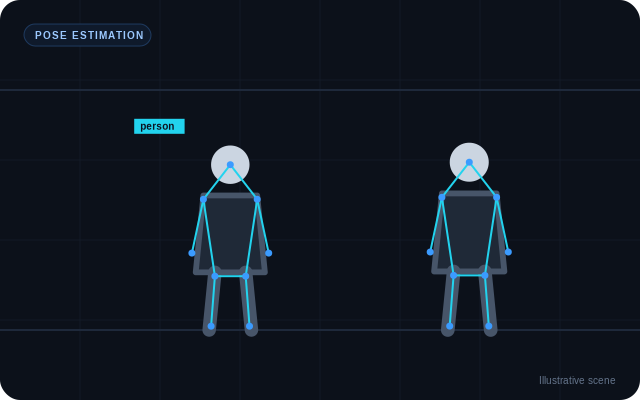
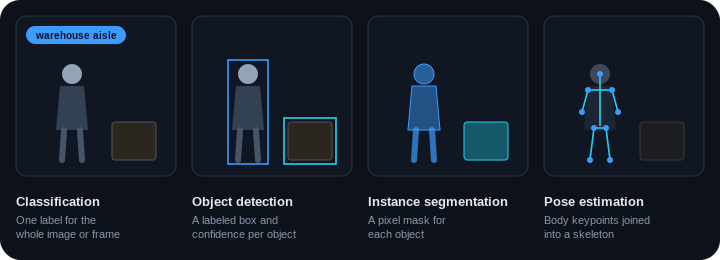
Pose estimation locates keypoints — such as shoulders, elbows, knees or the corners of an object — and connects them into a skeleton or structure. It adds information about posture and orientation that boxes cannot provide.
Definition
Pose estimation predicts the coordinates of predefined keypoints for each detected person or object, usually with a confidence per keypoint, and connects them into a skeleton or keypoint structure that describes posture or orientation.
Typical outputs
- Keypoint coordinates per person or object
- Confidence per keypoint
- Derived measures such as joint angles, posture class or fall indicators
Where it is used
Falls and unsafe postures
Indicating possible falls, kneeling under loads or reaching into machinery for safety review.
Ergonomics analysis
Estimating repetitive or awkward postures in workstations as input to ergonomic assessments.
Activity recognition input
Providing structured body motion as input for recognizing actions and activities.
How it works
Pose models either detect people first and then estimate keypoints within each detection, or predict all keypoints in the image and group them into people. The output is a set of keypoint coordinates that can be connected into a skeleton.
From keypoints to decisions
Keypoints become useful through rules or downstream models: angles that indicate bending, sudden changes that suggest a fall, or sequences that describe an activity. Pose estimation is therefore often one component of a safety or activity-recognition pipeline.
Edge considerations
Pose models run on Edge GPUs and accelerators. Camera placement that keeps people large enough in the frame is as important as model choice.
Running it at the edge
Model, resolution, frame rate and hardware are planned together for each project.
Design considerations
- Person size in frame. Keypoints need people to be reasonably large in the image; distant or tiny figures produce unreliable poses.
- Temporal smoothing. Poses jitter frame to frame; smoothing across frames improves stability for rules such as fall detection.
- Compute per person. Some approaches scale with the number of people in view, which affects hardware sizing in busy scenes.
Limitations & scope
- Occlusion by equipment, clothing and other people reduces keypoint accuracy.
- Pose estimates indicate posture; they do not diagnose injuries or medical conditions.
- Workplace use of posture analysis requires careful attention to employee privacy and consent.
Proof of Concept
Have a visual AI challenge? Let's prove it.
Share a video of what happens in your environment and describe the outcome you need. We review every request for technical feasibility, then agree the scope of a focused Proof of Concept (PoC) with you.
Every request is reviewed for technical feasibility. PoC scope, timing and terms are agreed individually.
Frequently asked questions
Does pose estimation identify people?
No. It estimates body keypoints and posture, not identity.
Can pose estimation detect falls reliably?
It can indicate likely falls, especially combined with tracking over time, but camera angle and occlusion matter. Alerts should be reviewed by a person.
Related topics
How this page connects to industries, use cases, AI tasks, input sources and deployment options.
Industries
Use Cases
- Athlete Pose and Technique Analysis
- Driver Fatigue and Distraction Monitoring
- Fall Detection in Care Settings
- Lameness Indicators in Livestock
- Man-Down and Worker Fall Detection
- Object Pose Estimation for Robotics
- Touchless Gesture Control
- Vision-Guided Bin Picking
- Visual Compliance Monitoring
- Workplace Safety Monitoring