Use CasePresence, seating and tamper bands
Cap and Closure Inspection
Verify that caps and closures are present, fully seated and straight, and that tamper bands are intact, on bottles and jars at line speed.
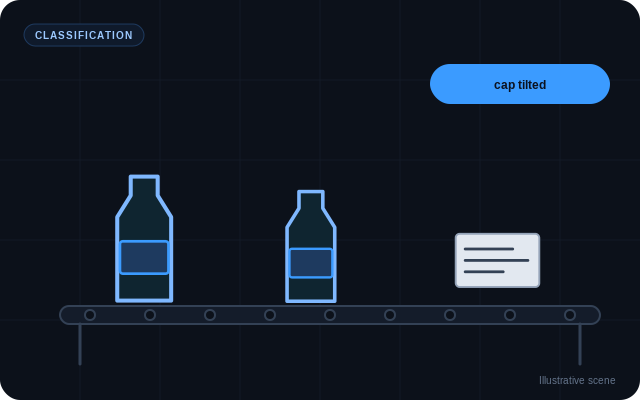
What can be checked
- Missing caps
- Tilted or high caps
- Broken tamper bands
What the team receives
- Reject signal
- Capping statistics per head
What the solution does
Leak prevention
Catches poorly seated and tilted caps that could lead to leaks.
Consumer safety
Checks that tamper-evident bands are present and unbroken.
Machine insight
Links tilted, loose or missing caps to the capping head that applied them, so maintenance can adjust it before defects build up.
The operational problem
Poorly seated caps cause leaks and complaints, and broken tamper bands affect consumer trust.
How visual intelligence helps
Cameras view each closure from several angles and classify missing, tilted or high caps and broken tamper bands. Defective units are rejected and statistics per capping head support maintenance.
Example visual workflow
- Containers pass the inspection station.
- Cameras view the cap from several angles.
- Defects are classified.
- Units are rejected and stats logged.
Illustrative workflow — the actual pipeline is designed for each site during the PoC.
Edge deployment considerations
Analysis runs at the line and keeps pace with capping speed, using short exposures and synchronized triggers.
How the solution is built
AI capabilities
The AI tasks this use case combines.
- Defect Detection
Defect detection locates and classifies specific, known defect types — scratches, cracks, dents, contamination, missing features — in images of products or assets.
- Image and Object Classification
Classification assigns a label to a whole image or to an individual object crop — good or defective, running or stopped, product variant A or B.
Visual inputs
Cameras and imaging that typically supply the video.
- Industrial and Machine Vision Cameras
Industrial and machine vision cameras capture sharp, consistent images at fixed positions with controlled lighting and triggering.
Deployment options
General approaches to evaluate, not tested hardware. Specific hardware is selected and validated for each project during the PoC.
- Edge AI Hardware Sizing
Sizing Edge AI hardware means matching compute, memory, power and enclosure to the real workload — the number of streams, resolution, frame rate, models and latency targets — under the site's environmental and installation constraints.
- Edge Deployment Architectures
Edge-first means processing video at or near where it is captured.
- Industrial and Ruggedized Edge AI Computers
Industrial Edge AI computers and ruggedized systems house AI-capable processors in enclosures built for factories, vehicles and outdoor sites — wide temperature ranges, vibration, dust and industrial power.
Practical factors to plan for
Real-world results depend as much on the environment and camera setup as on the model.
Site and setup
- Views. Several cameras may be needed around the neck.
- Speed. High-speed lines need short exposure.
Human review
Operators review rejects and maintain capping heads.
Limitations & scope
- Torque cannot be measured visually.
- Transparent caps need specific lighting.
Proof of Concept
Have a visual AI challenge? Let's prove it.
Share a video of what happens in your environment and describe the outcome you need. We review every request for technical feasibility, then agree the scope of a focused Proof of Concept (PoC) with you.
Example request: “We want to detect tilted caps and broken tamper bands on our sauce bottles.”
Every request is reviewed for technical feasibility. PoC scope, timing and terms are agreed individually.
Related topics
How this page connects to industries, use cases, AI tasks, input sources and deployment options.