AI TaskLocating known defect types
Defect Detection
Defect detection locates and classifies specific, known defect types — scratches, cracks, dents, contamination, missing features — in images of products or assets. It combines detection or segmentation with carefully defined defect classes.
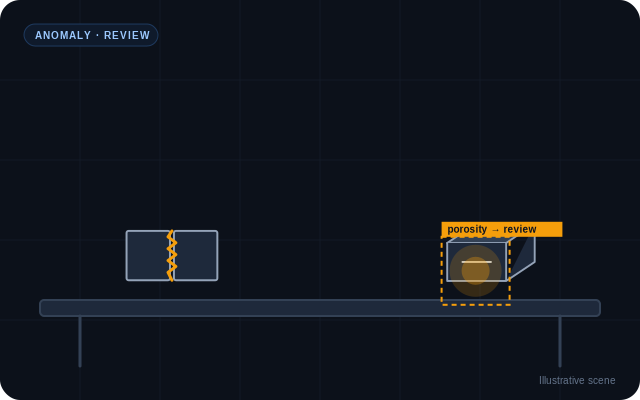
Definition
Defect detection is the application of detection, segmentation or classification models to find defined defect classes in images, outputting the location, extent and type of each defect, usually against agreed acceptance criteria.
Typical outputs
- Defect location as a box or mask
- Defect type and confidence
- Pass, fail or review decision per part or image
Where it is used
Product inspection
Finding surface and assembly defects on manufactured parts and packaging.
Asset inspection
Detecting cracks, corrosion or damage in imagery of infrastructure and equipment.
Food and material inspection
Spotting visible contamination, discoloration or damage on products.
How it works
Images are captured under controlled conditions, then a model trained on labeled defect examples locates and classifies defects. Rules convert detections into decisions, such as rejecting a part if a scratch exceeds a certain size.
Defining defects well
Most of the work is in defining what counts as a defect and collecting representative examples. Close collaboration with quality staff and a clear labeling guide are essential.
Edge considerations
Defect detection usually runs inline, on Edge hardware next to the camera, within strict latency limits.
Running it at the edge
Model, resolution, frame rate and hardware are planned together for each project.
Design considerations
- Imaging defines the limit. A defect that is not visible under the chosen lighting and resolution cannot be detected by any model.
- Balanced examples. Each defect class needs representative examples; rare classes may need data augmentation or anomaly detection as a complement.
- Latency budget. Inline inspection must complete within the cycle time, which constrains model size and resolution.
Limitations & scope
- Defect classes and acceptance limits must be defined precisely with quality or engineering experts.
- New or unseen defect types are not detected unless complemented by anomaly detection.
- Results are validated against your samples; generic models rarely meet production requirements without adaptation.
Proof of Concept
Have a visual AI challenge? Let's prove it.
Share a video of what happens in your environment and describe the outcome you need. We review every request for technical feasibility, then agree the scope of a focused Proof of Concept (PoC) with you.
Every request is reviewed for technical feasibility. PoC scope, timing and terms are agreed individually.
Frequently asked questions
How is defect detection different from anomaly detection?
Defect detection looks for known, defined defect types using labeled examples. Anomaly detection flags anything that differs from normal, including unknown issues.
Is defect detection the same as quality inspection?
Defect detection is the AI task. Quality inspection is the use case that combines it with imaging, line integration, rejection logic and reporting.
Related topics
How this page connects to industries, use cases, AI tasks, input sources and deployment options.
Industries
- Edge AI Video Intelligence for Aerospace
- Edge AI Video Intelligence for Automotive
- Edge AI Video Intelligence for Automotive Services
- Edge AI Video Intelligence for Consumer Goods
- Edge AI Video Intelligence for Electronics and Semiconductors
- Edge AI Video Intelligence for Energy
- Edge AI Video Intelligence for Food and Beverage
- Edge AI Video Intelligence for Infrastructure
- Edge AI Video Intelligence for Metals and Steel
- Edge AI Video Intelligence for Pharmaceuticals
- Edge AI Video Intelligence for Telecommunications
- Edge AI Video Intelligence for Textiles
- Edge AI Video Intelligence for Transportation and Rail
Use Cases
- Aircraft Surface Inspection
- Blister Pack Inspection
- Bridge and Tunnel Inspection Support
- Cap and Closure Inspection
- Casting Defect Detection
- Composite Defect Inspection
- Container Damage Inspection
- Conveyor Belt Monitoring
- Corrosion Detection
- Crack Detection on Concrete and Structures
- Egg Inspection and Counting
- Engine Borescope Inspection Support
- Fabric Defect Detection
- Fill Level Inspection
- Glass and Bottle Defect Inspection
- Industrial Visual Inspection
- Label Inspection
- Meat and Poultry Processing Inspection
- Package Damage Detection
- Packaging Inspection
- PCB Inspection
- Power Line Inspection
- Quality Inspection and Defect Detection
- Rack Damage Detection
- Railway Track Inspection
- Returns Inspection
- Robotic Visual Inspection
- Sewer and Pipe Inspection
- Solar Panel Inspection
- Solder Joint Inspection
- Steel and Metal Surface Inspection
- Surface Scratch and Cosmetic Defect Detection
- Tablet and Capsule Inspection
- Tire and Wheel Inspection
- Vehicle Damage Inspection
- Vial and Ampoule Inspection
- Weld Seam Inspection
- Wind Turbine Blade Inspection
- Wood and Lumber Defect Grading