Input SourceControlled imaging for inspection
Industrial and Machine Vision Cameras
Industrial and machine vision cameras capture sharp, consistent images at fixed positions with controlled lighting and triggering. They are the standard source for inline inspection, verification and measurement — and pair naturally with Edge AI computers at the line.
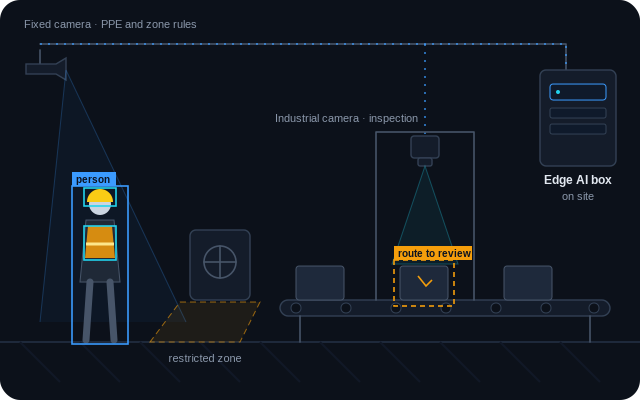
Where processing can run
- Industrial Edge AI computer at the line. Cameras connect to an industrial computer with GPU or accelerator that runs inspection models within the cycle time.
- Smart camera. Lightweight models can run on cameras with suitable onboard compute, where the vendor platform supports custom models.
What this source enables
Inline inspection
Consistent images of every part enable defect detection and verification at line speed.
Measurement
Calibrated, fixed geometry allows dimensional estimates within validated accuracy.
Traceability
Images linked to part or lot identifiers support quality records.
Designed for repeatability
Machine vision cameras exist to capture the same scene the same way, every time. That repeatability is what makes reliable automated inspection possible, and it is why they are the default choice for inline quality applications.
Pairing with Edge AI
Inline decisions must be made within the line’s cycle time, so processing happens next to the camera on an industrial Edge AI computer or, for lighter models, on a capable smart camera.
Planning the imaging
A good inspection project starts with imaging: which defects must be visible, at what size, under which lighting. The model is chosen once the images show the defects clearly.
What to consider
Practical factors that determine which architecture and models are feasible.
Platform and mission
- Lighting and optics. Lens choice, working distance and lighting design determine which defects are visible; they are designed together with the analytics.
- Triggering and timing. Cameras are usually triggered by sensors or line signals so each part is captured in the same position.
- Interfaces. Industrial cameras use interfaces such as GigE Vision or USB3 Vision; the Edge computer and software must support the chosen interface.
- Smart cameras. Some industrial cameras include onboard processing; their compute and openness are assessed per model.
Limitations & scope
- General-purpose CCTV cannot substitute for controlled machine vision imaging in fine inspection.
- Lighting and mechanical integration often take more effort than model development.
- Compatibility of camera interfaces and SDKs is confirmed for each hardware combination.
Proof of Concept
Have a visual AI challenge? Let's prove it.
Share a video of what happens in your environment and describe the outcome you need. We review every request for technical feasibility, then agree the scope of a focused Proof of Concept (PoC) with you.
Example request: “We have a machine vision camera on our labeling station and want to add a check for crooked labels.”
Every request is reviewed for technical feasibility. PoC scope, timing and terms are agreed individually.
Frequently asked questions
Do we need a new camera for inspection?
Often, yes, unless suitable machine vision cameras are already installed. Inspection usually needs controlled lighting and fixed geometry.
What is the difference between a machine vision camera and an IP camera?
Machine vision cameras are designed for triggered, precisely timed capture with controlled optics; IP cameras are designed for continuous streaming over networks.
Related topics
How this page connects to industries, use cases, AI tasks, input sources and deployment options.
Industries
- Edge AI Video Intelligence for Aerospace
- Edge AI Video Intelligence for Automotive
- Edge AI Video Intelligence for Consumer Goods
- Edge AI Video Intelligence for E-commerce Fulfillment
- Edge AI Video Intelligence for Electronics and Semiconductors
- Edge AI Video Intelligence for Food and Beverage
- Edge AI Video Intelligence for Metals and Steel
- Edge AI Video Intelligence for Pharmaceuticals
- Edge AI Video Intelligence for Recycling and Waste Management
- Edge AI Video Intelligence for Textiles
Use Cases
- Bakery Product Inspection
- Blister Pack Inspection
- Cap and Closure Inspection
- Casting Defect Detection
- Composite Defect Inspection
- Date and Lot Code Verification
- Dimensional Measurement from Images
- Egg Inspection and Counting
- Equipment Monitoring
- Fabric Defect Detection
- Fastener and Rivet Inspection
- Fill Level Inspection
- Foreign Material Detection in Food
- Glass and Bottle Defect Inspection
- Label Inspection
- Meat and Poultry Processing Inspection
- Missing Component Detection
- Order Packing Verification
- Ore and Rock Type Classification
- Package Damage Detection
- Packaging Inspection
- Part and Component Counting
- Part Orientation Detection
- PCB Inspection
- Pick-and-Place Guidance
- Pill Counting
- Produce Grading and Sorting
- Product Detection and Verification
- Production Line and Process Monitoring
- Quality Inspection and Defect Detection
- Recycling Contamination Detection
- Recycling Material Identification
- Returns Inspection
- Robotic Visual Inspection
- Serial Number and Part Marking Reading
- Shipping Label Reading
- Solder Joint Inspection
- Steel and Metal Surface Inspection
- Surface Scratch and Cosmetic Defect Detection
- Surgical Instrument Tray Verification
- Tablet and Capsule Inspection
- Tool Presence Verification
- Vial and Ampoule Inspection
- Wafer Defect Classification
- Weld Seam Inspection
- Wire Harness and Connector Inspection
- Wood and Lumber Defect Grading