Use CaseDispenser use at care entries
Hand Hygiene Compliance Awareness
Measure anonymous hand-sanitizer use at ward entries and care zones to support hygiene programs with aggregated compliance indicators.
What can be checked
- Entries into zones
- Dispenser use
- Missed opportunities
What the team receives
- Aggregated compliance rates
- Trends per zone
What the solution does
Program support
Provides continuous, objective data alongside audits.
Trends
Shows whether hygiene programs improve compliance over time.
Anonymous
Measures behavior in aggregate without identifying staff.
The operational problem
Hand hygiene audits are infrequent, and behavior changes when people know they are being observed.
How visual intelligence helps
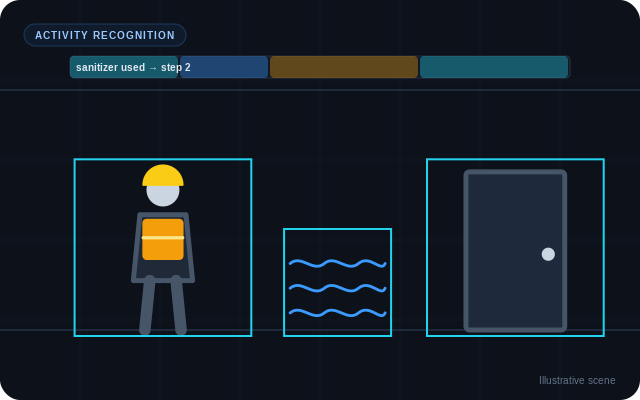
Cameras detect entries into care zones and dispenser use, producing aggregated compliance rates per zone and time.
Example visual workflow
- Cameras view entries and dispensers.
- Entries and dispenser use are detected.
- Rates are aggregated.
- Teams review.
Illustrative workflow — the actual pipeline is designed for each site during the PoC.
Edge deployment considerations
Processing runs on an Edge device on the ward; video stays on site and only aggregated counts are reported.
How the solution is built
AI capabilities
The AI tasks this use case combines.
- Action and Activity Recognition
Action recognition identifies short actions — picking, lifting, opening a door — while activity recognition describes longer sequences such as a loading operation or a procedure.
- Counting and Measurement
Counting and measurement convert detections, tracks and masks into quantities — how many objects, how long they stayed, how big they are, how full an area is.
Visual inputs
Cameras and imaging that typically supply the video.
- Depth, Stereo and 3D Cameras
Depth cameras measure distance to every point in view, using stereo vision, structured light or time-of-flight.
- IP and Network Cameras
IP cameras stream digital video over standard networks and are the most common source for Edge AI video analytics.
Deployment options
General approaches to evaluate, not tested hardware. Specific hardware is selected and validated for each project during the PoC.
- Camera and VMS Integration
Most projects start with cameras that are already installed.
- Edge AI Hardware Sizing
Sizing Edge AI hardware means matching compute, memory, power and enclosure to the real workload — the number of streams, resolution, frame rate, models and latency targets — under the site's environmental and installation constraints.
- Edge Deployment Architectures
Edge-first means processing video at or near where it is captured.
- Industrial and Ruggedized Edge AI Computers
Industrial Edge AI computers and ruggedized systems house AI-capable processors in enclosures built for factories, vehicles and outdoor sites — wide temperature ranges, vibration, dust and industrial power.
Practical factors to plan for
Real-world results depend as much on the environment and camera setup as on the model.
Site and setup
- Privacy. Report aggregated data only.
- Dispenser placement. Dispensers must be visible.
Human review
Infection prevention teams interpret trends. Not for individual evaluation.
Limitations & scope
- Handwashing technique is not assessed.
- Consultation with staff is required.
Proof of Concept
Have a visual AI challenge? Let's prove it.
Share a video of what happens in your environment and describe the outcome you need. We review every request for technical feasibility, then agree the scope of a focused Proof of Concept (PoC) with you.
Example request: “We want anonymous sanitizer use rates at the entries of two wards.”
Every request is reviewed for technical feasibility. PoC scope, timing and terms are agreed individually.
Related topics
How this page connects to industries, use cases, AI tasks, input sources and deployment options.