AI TaskUnderstanding what happens over time
Action and Activity Recognition
Action recognition identifies short actions — picking, lifting, opening a door — while activity recognition describes longer sequences such as a loading operation or a procedure. Both analyze motion over multiple frames rather than single images.
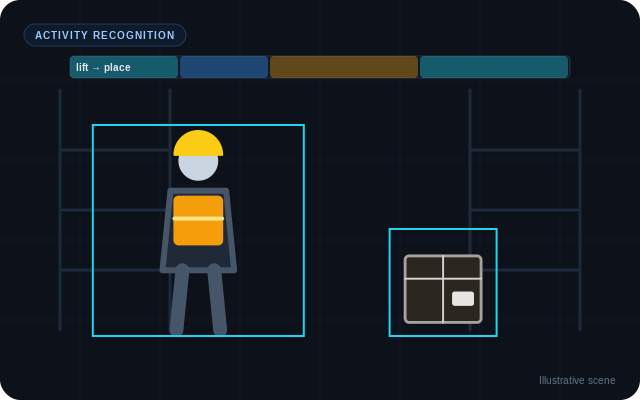
Definition
Action recognition classifies short segments of video into actions, using motion across frames. Activity recognition combines actions, objects and context over longer periods to describe what is happening, such as a step in a procedure or a loading cycle.
Typical outputs
- Action or activity labels with start and end times
- Confidence per recognized action
- Sequences of steps for procedure or cycle analysis
Where it is used
Procedure and step compliance
Checking that visible steps of a procedure occur, and in the right order.
Operational cycles
Measuring loading, assembly or turnaround cycles from start and end actions.
Safety-relevant actions
Flagging actions such as climbing, reaching into hazards or lifting incorrectly for review.
How it works
Action models analyze short clips, either directly from pixels or from sequences of pose keypoints, and output action labels. Activity recognition combines these with detected objects, zones and timing to describe longer events.
Start simple
The most reliable activity solutions often begin with simpler building blocks: a vehicle arrives, a forklift enters, the door closes. Dedicated action models are added where those building blocks cannot express the question.
Edge considerations
Clip-based models are heavier than frame-based ones. Skeleton-based approaches and event rules keep activity recognition feasible on Edge hardware.
Running it at the edge
Model, resolution, frame rate and hardware are planned together for each project.
Design considerations
- Temporal context costs compute. Models that analyze clips rather than frames need more memory and compute; skeleton-based approaches using pose keypoints are lighter.
- Defining actions clearly. Actions must be visually distinct and consistently defined; ambiguous definitions lead to unreliable recognition.
- Rule-based alternatives. Many "activities" can be recognized with detection, tracking and zone rules, which are simpler to deploy.
Limitations & scope
- Actions that look similar, or are partly hidden, are hard to distinguish.
- Training data for specific actions is often scarce and must be collected from the target environment.
- Recognizing actions of people at work raises privacy and acceptance questions that must be addressed upfront.
Proof of Concept
Have a visual AI challenge? Let's prove it.
Share a video of what happens in your environment and describe the outcome you need. We review every request for technical feasibility, then agree the scope of a focused Proof of Concept (PoC) with you.
Every request is reviewed for technical feasibility. PoC scope, timing and terms are agreed individually.
Frequently asked questions
What is the difference between an action and an activity?
An action is short and specific, such as lifting a box. An activity is a longer sequence, such as loading a truck, composed of several actions and context.
Is a special model always needed?
No. Many activity questions can be answered by combining detection, tracking and zone rules, which is often more robust and easier to maintain.
Related topics
How this page connects to industries, use cases, AI tasks, input sources and deployment options.
Industries
Use Cases
- Aircraft Turnaround Monitoring
- Animal Behavior Monitoring
- Assembly Step Verification
- Dock Door Monitoring
- Driver Fatigue and Distraction Monitoring
- Fall Detection in Care Settings
- Furnace and Ladle Monitoring
- Hand Hygiene Compliance Awareness
- Heavy Equipment Utilization Tracking
- Loading and Unloading Monitoring
- Man-Down and Worker Fall Detection
- Manual Workstation Cycle Time Analysis
- Production Line and Process Monitoring
- Self-Checkout Scan Awareness
- Service Bay Monitoring
- Touchless Gesture Control
- Visual Compliance Monitoring