Use CaseHairnets, gloves and handwashing zones
Hygiene Compliance Monitoring
Check visible hygiene requirements at entries and process areas — hairnets, beard covers, gloves, coats — and use of handwashing stations, as support for hygiene teams.
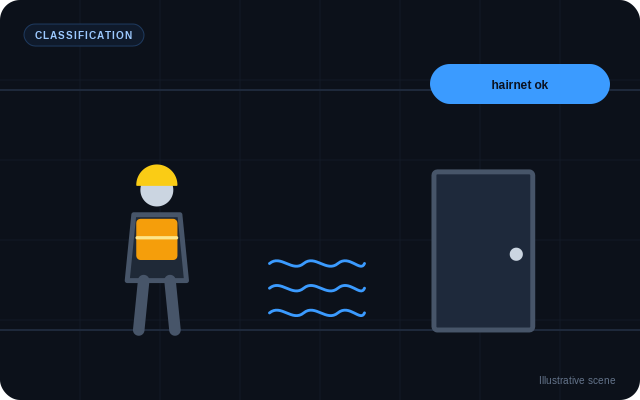
What can be checked
- Hairnets and beard covers
- Gloves and coats
- Handwashing station use
What the team receives
- Aggregated compliance rates
- Real-time reminders at entries
What the solution does
Reminders
Shows a prompt at the hygiene station or entry point when a handwashing or sanitizing step appears to be missed.
Audit support
Provides compliance trends that support hygiene audits.
Privacy-aware
Reports aggregated rates instead of tracking individual employees.
The operational problem
Hygiene rules such as hairnets, gloves and coats are critical in food production but hard to check consistently at busy entries and shift changes.
How visual intelligence helps
Cameras check visible protective items at entries and show reminders, with aggregated data for audits.
Example visual workflow
- A camera views the hygiene lock or entry.
- Protective items are detected.
- A display shows a reminder if items are missing.
- Aggregated rates are reported.
Illustrative workflow — the actual pipeline is designed for each site during the PoC.
Edge deployment considerations
Processing runs on an Edge device at the entry with no video stored by default; only aggregated compliance counts are kept.
How the solution is built
AI capabilities
The AI tasks this use case combines.
- Attribute Recognition
Attribute recognition determines properties of an object found by a detector — color, type, state, whether a helmet or vest is worn, whether a door is open.
- Object Detection
Object detection finds and labels the objects in an image or video frame and marks each one with a bounding box.
Visual inputs
Cameras and imaging that typically supply the video.
- IP and Network Cameras
IP cameras stream digital video over standard networks and are the most common source for Edge AI video analytics.
Deployment options
General approaches to evaluate, not tested hardware. Specific hardware is selected and validated for each project during the PoC.
- Camera and VMS Integration
Most projects start with cameras that are already installed.
- Edge AI Hardware Sizing
Sizing Edge AI hardware means matching compute, memory, power and enclosure to the real workload — the number of streams, resolution, frame rate, models and latency targets — under the site's environmental and installation constraints.
- Edge Deployment Architectures
Edge-first means processing video at or near where it is captured.
Practical factors to plan for
Real-world results depend as much on the environment and camera setup as on the model.
Site and setup
- Privacy. Focus on aggregated compliance rather than individuals.
- Colors. Protective clothing colors should be distinct.
Human review
Hygiene teams review trends. Reminders support staff; they are not disciplinary tools.
Limitations & scope
- Handwashing quality cannot be fully assessed visually.
- Employee consultation is required.
Proof of Concept
Have a visual AI challenge? Let's prove it.
Share a video of what happens in your environment and describe the outcome you need. We review every request for technical feasibility, then agree the scope of a focused Proof of Concept (PoC) with you.
Example request: “We want a reminder screen when someone enters the production hall without a hairnet.”
Every request is reviewed for technical feasibility. PoC scope, timing and terms are agreed individually.
Related topics
How this page connects to industries, use cases, AI tasks, input sources and deployment options.