AI TaskProperties of detected objects
Attribute Recognition
Attribute recognition determines properties of an object found by a detector — color, type, state, whether a helmet or vest is worn, whether a door is open. It adds descriptive detail to detection without identifying individuals.
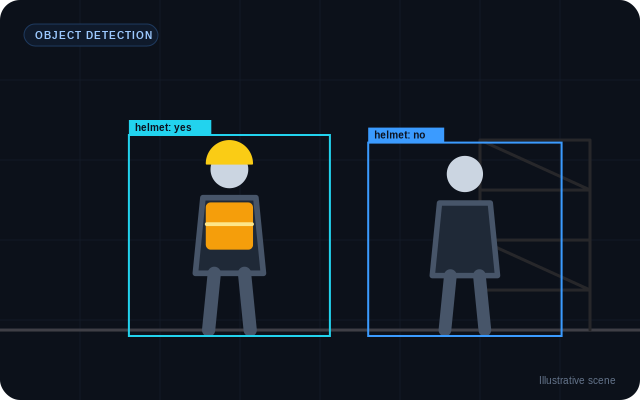
Definition
Attribute recognition predicts one or more properties of a detected object, typically by classifying a crop of the object into multiple attribute labels, such as color, category, state or the presence of accessories and equipment.
Typical outputs
- Attribute labels per object, such as color, type or state
- Confidence per attribute
- Combined descriptors used by rules, such as "person without vest"
Where it is used
PPE checks
Determining whether a detected person wears specific equipment, such as a helmet or high-visibility vest.
Vehicle and object descriptors
Assigning color, type or configuration to vehicles, containers or products.
State recognition
Recognizing whether doors, valves, covers or barriers are open or closed.
How it works
After detection, each object crop passes through a classifier that predicts several attributes at once. Rules combine these attributes with zones and time to produce events such as “vehicle of type X in lane Y” or “person without required vest in zone Z”.
Responsible scope
Attributes are limited to operational properties of objects and equipment. Sensitive characteristics of people are not inferred.
Edge considerations
Attribute classifiers are light, but run per object. Hardware sizing considers the expected number of objects per frame.
Running it at the edge
Model, resolution, frame rate and hardware are planned together for each project.
Design considerations
- Two-stage design. A detector finds objects; a lightweight multi-label classifier assigns attributes to each crop.
- Crop resolution. Small attributes, such as gloves or safety glasses, need objects to appear large enough in the frame.
- Scales with object count. Attribute models run per object, so busy scenes increase compute requirements.
Limitations & scope
- Small or partly hidden attributes are difficult to recognize reliably.
- Color perception varies with lighting and camera settings, so color attributes need careful evaluation.
- Attribute recognition for people must avoid sensitive or protected characteristics; such attributes are out of scope.
Proof of Concept
Have a visual AI challenge? Let's prove it.
Share a video of what happens in your environment and describe the outcome you need. We review every request for technical feasibility, then agree the scope of a focused Proof of Concept (PoC) with you.
Every request is reviewed for technical feasibility. PoC scope, timing and terms are agreed individually.
Frequently asked questions
Is this how PPE compliance works?
Often, yes. A person is detected and attributes such as "helmet" or "vest" are recognized, or PPE items are detected directly as separate objects. The approach depends on the footage.
Do you recognize attributes like age or gender?
No. Sensitive personal attributes are outside the scope of these solutions.
Related topics
How this page connects to industries, use cases, AI tasks, input sources and deployment options.