Use CaseVisible quality checks on processing lines
Meat and Poultry Processing Inspection
Support visible quality checks on meat and poultry processing lines — trim, defects, bruising, foreign material and product presentation — alongside official inspection.
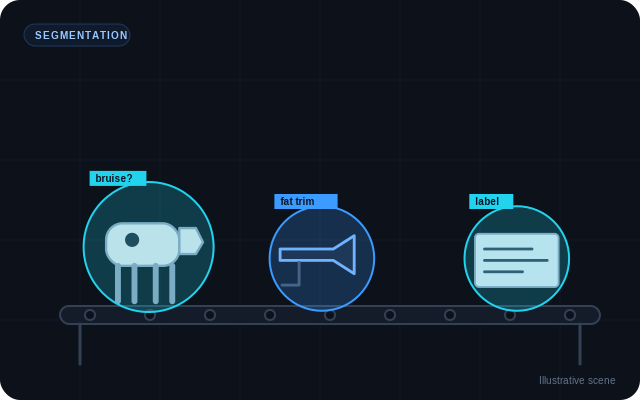
What can be checked
- Bruises and visible defects
- Trim and fat coverage indications
- Foreign material on product
What the team receives
- Flags and grades per product
- Defect statistics per supplier or shift
What the solution does
Consistent checks
Applies the same visual criteria all shift.
Supplier feedback
Links visible defects to suppliers, flocks and batches, giving procurement and quality teams evidence for supplier discussions.
Foreign material support
Adds a visual layer to existing detection systems.
The operational problem
Visual quality checks on fast processing lines are tiring and inconsistent, and defects found later reduce value or trigger complaints.
How visual intelligence helps
Cameras assess visible defects and trim on every product, flagging items for quality staff and building statistics per supplier and shift.
Example visual workflow
- Products pass cameras on the line.
- Visible defects and trim are assessed.
- Products are flagged or graded.
- Statistics are reported to quality teams.
Illustrative workflow — the actual pipeline is designed for each site during the PoC.
Edge deployment considerations
Washdown-rated Edge hardware near the line processes images in real time, and images stay inside the plant network.
How the solution is built
AI capabilities
The AI tasks this use case combines.
- Defect Detection
Defect detection locates and classifies specific, known defect types — scratches, cracks, dents, contamination, missing features — in images of products or assets.
- Semantic Segmentation
Semantic segmentation assigns a class to every pixel of an image — road, floor, water, smoke, crop, background — producing a map of regions rather than individual objects.
Visual inputs
Cameras and imaging that typically supply the video.
- Industrial and Machine Vision Cameras
Industrial and machine vision cameras capture sharp, consistent images at fixed positions with controlled lighting and triggering.
- Industrial X-ray Imaging
Industrial X-ray systems image the inside of products, packages, castings and electronics.
Deployment options
General approaches to evaluate, not tested hardware. Specific hardware is selected and validated for each project during the PoC.
- Edge AI Hardware Sizing
Sizing Edge AI hardware means matching compute, memory, power and enclosure to the real workload — the number of streams, resolution, frame rate, models and latency targets — under the site's environmental and installation constraints.
- Edge Deployment Architectures
Edge-first means processing video at or near where it is captured.
- Industrial and Ruggedized Edge AI Computers
Industrial Edge AI computers and ruggedized systems house AI-capable processors in enclosures built for factories, vehicles and outdoor sites — wide temperature ranges, vibration, dust and industrial power.
Practical factors to plan for
Real-world results depend as much on the environment and camera setup as on the model.
Site and setup
- Hygiene. Equipment must withstand washdown and meet hygiene design rules.
- Natural variation. Products vary widely; specifications must be agreed precisely.
Human review
Quality staff confirm flagged products. Official veterinary inspection remains unaffected.
Limitations & scope
- Analytics do not replace official meat inspection or food safety controls.
- Internal defects and bone fragments inside product are not visible to cameras.
Proof of Concept
Have a visual AI challenge? Let's prove it.
Share a video of what happens in your environment and describe the outcome you need. We review every request for technical feasibility, then agree the scope of a focused Proof of Concept (PoC) with you.
Example request: “We want to flag wing bruising on chicken carcasses after evisceration for our quality team.”
Every request is reviewed for technical feasibility. PoC scope, timing and terms are agreed individually.
Related topics
How this page connects to industries, use cases, AI tasks, input sources and deployment options.