Use CaseDishes and trays against specification
Portion and Plating Verification
Compare plated dishes, meal trays and food portions with their specification — components present, portion coverage, arrangement — before they leave the kitchen or catering line.
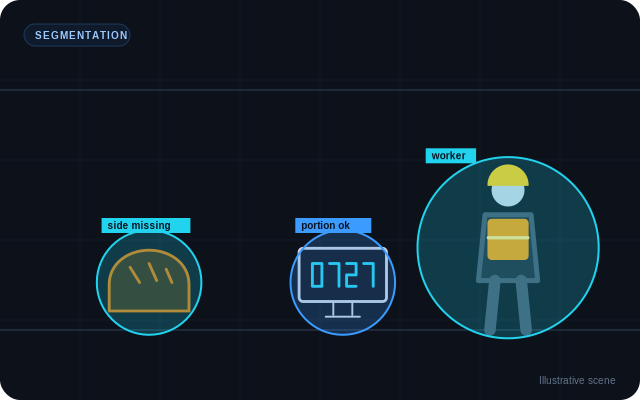
What can be checked
- Components present on plate or tray
- Estimated portion coverage
- Missing or extra items
What the team receives
- Pass or review per dish or tray
- Consistency statistics per station
What the solution does
Consistent dishes
Keeps presentation and portions aligned with the spec.
Fewer missing items
Checks trays and plates against the expected components, so missing items are caught before meals leave the kitchen.
Station insight
Shows which stations, shifts and dishes vary most from the specification, which helps target training.
The operational problem
Kitchens and catering units produce thousands of dishes and trays, and missing components or inconsistent portions affect cost and satisfaction.
How visual intelligence helps
An overhead camera segments the items on each plate or tray and compares them with the specification, prompting staff when something is missing or off.
Example visual workflow
- An overhead camera captures each dish or tray.
- Components are segmented and identified.
- The result is compared with the specification.
- Staff see a confirmation or a correction hint.
Illustrative workflow — the actual pipeline is designed for each site during the PoC.
Edge deployment considerations
Analysis runs on a compact Edge device at the pass or tray line, without sending images of staff off site.
How the solution is built
AI capabilities
The AI tasks this use case combines.
- Instance Segmentation
Instance segmentation detects each object and outlines its exact pixels — a separate mask per object.
- Object Detection
Object detection finds and labels the objects in an image or video frame and marks each one with a bounding box.
Visual inputs
Cameras and imaging that typically supply the video.
- IP and Network Cameras
IP cameras stream digital video over standard networks and are the most common source for Edge AI video analytics.
Deployment options
General approaches to evaluate, not tested hardware. Specific hardware is selected and validated for each project during the PoC.
- Camera and VMS Integration
Most projects start with cameras that are already installed.
- Edge AI Hardware Sizing
Sizing Edge AI hardware means matching compute, memory, power and enclosure to the real workload — the number of streams, resolution, frame rate, models and latency targets — under the site's environmental and installation constraints.
- Edge Deployment Architectures
Edge-first means processing video at or near where it is captured.
Practical factors to plan for
Real-world results depend as much on the environment and camera setup as on the model.
Site and setup
- Visual estimates. Portion size from images is an estimate unless combined with weighing.
- Menu changes. Specifications must be updated as menus change.
Human review
Kitchen staff review flagged dishes and correct them before service.
Limitations & scope
- Portion weight cannot be measured precisely from images.
- Staff-facing systems require transparency and consultation.
Proof of Concept
Have a visual AI challenge? Let's prove it.
Share a video of what happens in your environment and describe the outcome you need. We review every request for technical feasibility, then agree the scope of a focused Proof of Concept (PoC) with you.
Example request: “We want to verify that hospital meal trays contain all ordered components before delivery to wards.”
Every request is reviewed for technical feasibility. PoC scope, timing and terms are agreed individually.
Related topics
How this page connects to industries, use cases, AI tasks, input sources and deployment options.