Use CaseCosmetic and particle checks
Vial and Ampoule Inspection
Support inspection of vials, ampoules and syringes for visible cosmetic defects, cracks and particles, complementing manual and automated inspection.
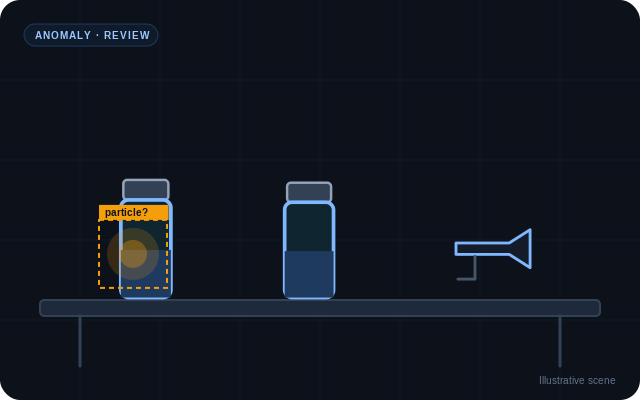
What can be checked
- Cracks and chips in glass
- Visible particles
- Cosmetic defects such as scratches
What the team receives
- Accept or reject suggestion
- Defect images
What the solution does
False reject reduction
Helps separate cosmetic noise from real defects.
Consistency
Applies the same classification criteria on every shift, reducing variability between human inspectors.
Data
Supports trending of defect types across batches and lines.
The operational problem
Visual inspection of parenterals produces many false rejects and depends on inspector performance.
How visual intelligence helps
AI models classify defects in images captured while containers rotate, helping to separate harmless cosmetic marks from real defects and particles. Results support inspectors and inspection machines rather than replacing qualified programs.
Example visual workflow
- Containers are rotated and imaged.
- Images are analyzed for defects and particles.
- Results are suggested to inspectors or machines.
- Data supports batch review.
Illustrative workflow — the actual pipeline is designed for each site during the PoC.
Edge deployment considerations
Processing runs on validated systems at the inspection machine, with data integrity controls appropriate to GMP.
How the solution is built
AI capabilities
The AI tasks this use case combines.
- Defect Detection
Defect detection locates and classifies specific, known defect types — scratches, cracks, dents, contamination, missing features — in images of products or assets.
- Visual Anomaly Detection
Visual anomaly detection learns what normal looks like and flags images, regions or events that deviate from it.
Visual inputs
Cameras and imaging that typically supply the video.
- High-Speed Cameras
High-speed cameras capture hundreds or thousands of frames per second, revealing events too fast for standard cameras — on fast packaging lines, in machinery or in process analysis.
- Industrial and Machine Vision Cameras
Industrial and machine vision cameras capture sharp, consistent images at fixed positions with controlled lighting and triggering.
Deployment options
General approaches to evaluate, not tested hardware. Specific hardware is selected and validated for each project during the PoC.
- Edge AI Hardware Sizing
Sizing Edge AI hardware means matching compute, memory, power and enclosure to the real workload — the number of streams, resolution, frame rate, models and latency targets — under the site's environmental and installation constraints.
- Edge Deployment Architectures
Edge-first means processing video at or near where it is captured.
- Industrial and Ruggedized Edge AI Computers
Industrial Edge AI computers and ruggedized systems house AI-capable processors in enclosures built for factories, vehicles and outdoor sites — wide temperature ranges, vibration, dust and industrial power.
Practical factors to plan for
Real-world results depend as much on the environment and camera setup as on the model.
Site and setup
- Regulation. Parenteral inspection is strictly regulated.
- Motion. Particles are detected through container rotation.
Human review
Qualified inspectors and QA make final decisions. AI is introduced through validation.
Limitations & scope
- Requires extensive validation.
- Does not replace qualified inspection programs.
Proof of Concept
Have a visual AI challenge? Let's prove it.
Share a video of what happens in your environment and describe the outcome you need. We review every request for technical feasibility, then agree the scope of a focused Proof of Concept (PoC) with you.
Example request: “We want to evaluate whether AI can reduce false rejects of vials with harmless cosmetic marks.”
Every request is reviewed for technical feasibility. PoC scope, timing and terms are agreed individually.
Related topics
How this page connects to industries, use cases, AI tasks, input sources and deployment options.