AI TaskLocating and decoding printed codes
Barcode and QR Code Reading
Barcode and QR code reading locates 1D barcodes, 2D codes such as QR and Data Matrix, and decodes their content from camera images — including codes that are small, angled, partly damaged or moving past on a conveyor.
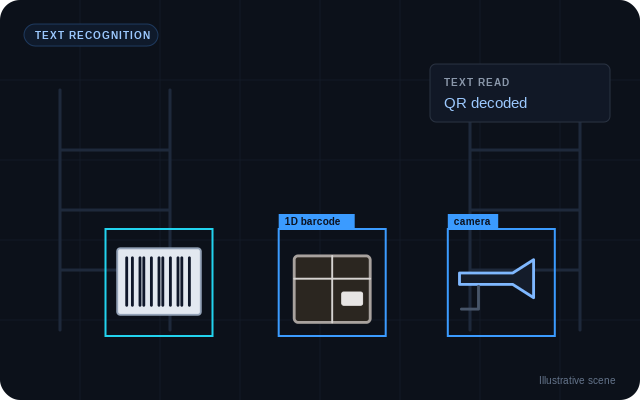
Definition
Code reading has two steps. A detector finds where codes are in the image, including several codes at once and codes at arbitrary angles; a decoder then reads the symbol's content. Learned detectors make the first step more robust to clutter and distance, while decoding follows the code standard.
Typical outputs
- Code location and type per image
- Decoded content with a read or no-read result
- Print-quality indicators where the setup allows
Where it is used
Parcel and pallet identification
Reading shipping and pallet codes at docks, conveyors and sorters without handheld scanning.
Part traceability
Reading Data Matrix and direct part marks on components through production steps.
Pack verification
Checking that the right code is on the right product before it leaves the line.
How it works
A detection model finds candidate codes anywhere in the frame, crops them and corrects their orientation. A decoder then reads each symbol and reports whether the read succeeded. Results can be matched against expected values from an order, a work order or a shipping manifest.
When vision beats a fixed scanner
Fixed scanners are excellent for one code in a known position. Camera-based reading helps when codes appear in variable positions, when many codes must be read at once, or when the same camera also checks labels, damage or presence.
Edge considerations
Reading on an Edge device keeps decisions fast enough for diverters and reject mechanisms. Only the decoded values and exceptions need to leave the line.
Running it at the edge
Model, resolution, frame rate and hardware are planned together for each project.
Design considerations
- Resolution per module. Each bar or module of a code needs enough pixels; small codes at distance need higher resolution or optics.
- Motion blur. Codes on fast conveyors need short exposure times and good lighting to stay decodable.
- Local decoding. Reading at the edge keeps routing and verification decisions within the line's timing budget.
Limitations & scope
- Heavily damaged, wrinkled or glare-covered codes can still fail to decode.
- Fixed industrial code readers may be the better choice for single, well-presented codes; vision adds value with many codes, variable positions or combined checks.
- Formal print-quality grading against code standards needs verifiers configured for that purpose.
Proof of Concept
Have a visual AI challenge? Let's prove it.
Share a video of what happens in your environment and describe the outcome you need. We review every request for technical feasibility, then agree the scope of a focused Proof of Concept (PoC) with you.
Example request: “We want to read all barcodes on the visible face of inbound pallets as they pass the dock door.”
Every request is reviewed for technical feasibility. PoC scope, timing and terms are agreed individually.
Frequently asked questions
Is this the same as OCR?
No. OCR reads human-readable characters. Code reading decodes machine-readable symbols. Many projects combine both, for example a barcode and a printed lot number.
Can several codes be read in one image?
Yes. A detector can locate many codes per frame, for example all parcels on a pallet face.
Related topics
How this page connects to industries, use cases, AI tasks, input sources and deployment options.