Use CaseVehicle identification numbers from images
VIN Reading
Read vehicle identification numbers from windshield plates, door labels and stamped frames to speed up vehicle check-in, logistics and inspection workflows.
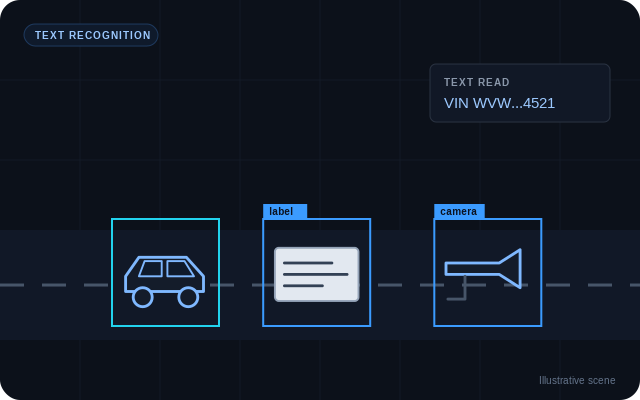
What can be checked
- VIN plates and labels
- VIN characters
- VIN barcodes where present
What the team receives
- Read VIN with check-digit validation
- Vehicle record match
What the solution does
Faster check-in
Removes manual typing of 17-character VINs at check-in.
Fewer errors
Checks each VIN's format and check digit where applicable, and flags mismatches with expected vehicle records.
Logistics records
Links vehicles to records at terminals and dealers.
The operational problem
Vehicle logistics and services depend on recording VINs, and typing 17-character codes by hand is slow and error-prone.
How visual intelligence helps
OCR reads VINs from plates, labels or barcodes and validates them with the check digit before matching vehicle records.
Example visual workflow
- Staff or a fixed camera capture the VIN location.
- Characters are read and validated.
- The VIN is matched with vehicle records.
- Exceptions are handled by staff.
Illustrative workflow — the actual pipeline is designed for each site during the PoC.
Edge deployment considerations
Reading runs on a handheld or lane-side device, so check-in works without waiting for remote processing.
How the solution is built
AI capabilities
The AI tasks this use case combines.
- Barcode and QR Code Reading
Barcode and QR code reading locates 1D barcodes, 2D codes such as QR and Data Matrix, and decodes their content from camera images — including codes that are small, angled, partly damaged or moving past on a conveyor.
- OCR and Text Recognition
Optical character recognition (OCR) reads text visible in images — labels, codes, container numbers, displays and gauges.
Visual inputs
Cameras and imaging that typically supply the video.
- IP and Network Cameras
IP cameras stream digital video over standard networks and are the most common source for Edge AI video analytics.
- Mobile Device Cameras
Smartphones and tablets put capable cameras and processors in the hands of field teams.
Deployment options
General approaches to evaluate, not tested hardware. Specific hardware is selected and validated for each project during the PoC.
- Camera and VMS Integration
Most projects start with cameras that are already installed.
- Edge AI Hardware Sizing
Sizing Edge AI hardware means matching compute, memory, power and enclosure to the real workload — the number of streams, resolution, frame rate, models and latency targets — under the site's environmental and installation constraints.
- Edge Deployment Architectures
Edge-first means processing video at or near where it is captured.
- Standalone Edge AI Devices
Standalone Edge AI devices are compact, self-contained units — AI boxes or smart cameras — that process video locally at a single location.
Practical factors to plan for
Real-world results depend as much on the environment and camera setup as on the model.
Site and setup
- Reflections. Windshield glass reflects light and hides characters.
- Check digits. Validation catches many misreads.
Human review
Low-confidence reads are confirmed by staff before vehicle records are updated.
Limitations & scope
- Dirty or damaged plates may be unreadable.
- VIN data use must follow privacy rules where linked to owners.
Proof of Concept
Have a visual AI challenge? Let's prove it.
Share a video of what happens in your environment and describe the outcome you need. We review every request for technical feasibility, then agree the scope of a focused Proof of Concept (PoC) with you.
Example request: “We want to read VINs through windshields at our vehicle terminal check-in with a handheld device.”
Every request is reviewed for technical feasibility. PoC scope, timing and terms are agreed individually.
Related topics
How this page connects to industries, use cases, AI tasks, input sources and deployment options.