Use CaseEngraved, stamped and printed identifiers
Serial Number and Part Marking Reading
Read serial numbers, part numbers and direct part marks that are laser-engraved, dot-peened, stamped or printed on components, enabling traceability without manual typing.
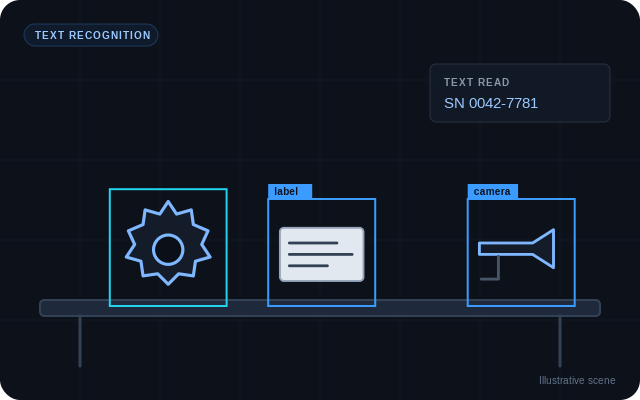
What can be checked
- Engraved and stamped characters
- Printed serial and part numbers
- Marking quality issues
What the team receives
- Read identifier with confidence
- Traceability record per part
What the solution does
No manual typing
Removes transcription errors from traceability.
Works on metal
Reads engraved and stamped marks with the right lighting.
Format validation
Checks identifiers against expected patterns.
The operational problem
Traceability depends on recording serial and part numbers, and manual typing of engraved or stamped marks is slow and causes errors.
How visual intelligence helps
OCR models trained for industrial markings read the characters under suitable lighting and validate them against expected formats before records are updated.
Example visual workflow
- The part is presented to the camera at a station.
- Characters are located and read.
- The identifier is validated against expected formats.
- The record is written to the traceability system.
Illustrative workflow — the actual pipeline is designed for each site during the PoC.
Edge deployment considerations
Reading runs on an Edge computer at the station and integrates with MES or traceability systems.
How the solution is built
AI capabilities
The AI tasks this use case combines.
- Barcode and QR Code Reading
Barcode and QR code reading locates 1D barcodes, 2D codes such as QR and Data Matrix, and decodes their content from camera images — including codes that are small, angled, partly damaged or moving past on a conveyor.
- OCR and Text Recognition
Optical character recognition (OCR) reads text visible in images — labels, codes, container numbers, displays and gauges.
Visual inputs
Cameras and imaging that typically supply the video.
- Industrial and Machine Vision Cameras
Industrial and machine vision cameras capture sharp, consistent images at fixed positions with controlled lighting and triggering.
Deployment options
General approaches to evaluate, not tested hardware. Specific hardware is selected and validated for each project during the PoC.
- Edge AI Hardware Sizing
Sizing Edge AI hardware means matching compute, memory, power and enclosure to the real workload — the number of streams, resolution, frame rate, models and latency targets — under the site's environmental and installation constraints.
- Edge Deployment Architectures
Edge-first means processing video at or near where it is captured.
- Industrial and Ruggedized Edge AI Computers
Industrial Edge AI computers and ruggedized systems house AI-capable processors in enclosures built for factories, vehicles and outdoor sites — wide temperature ranges, vibration, dust and industrial power.
Practical factors to plan for
Real-world results depend as much on the environment and camera setup as on the model.
Site and setup
- Low contrast. Engraved marks on metal have low contrast; angled lighting reveals them.
- Curved surfaces. Marks on shafts and round parts need suitable viewing angles.
Human review
Low-confidence reads are confirmed by operators before records are updated.
Limitations & scope
- Worn, painted-over or damaged marks may be unreadable.
- Character formats must be defined in advance.
Proof of Concept
Have a visual AI challenge? Let's prove it.
Share a video of what happens in your environment and describe the outcome you need. We review every request for technical feasibility, then agree the scope of a focused Proof of Concept (PoC) with you.
Example request: “We want to read laser-engraved serial numbers on machined steel shafts at our final inspection station.”
Every request is reviewed for technical feasibility. PoC scope, timing and terms are agreed individually.
Related topics
How this page connects to industries, use cases, AI tasks, input sources and deployment options.