AI TaskReading text in images and video
OCR and Text Recognition
Optical character recognition (OCR) reads text visible in images — labels, codes, container numbers, displays and gauges. In video analytics it usually combines a text-detection step with a recognition model, and works best on clear, legible text.
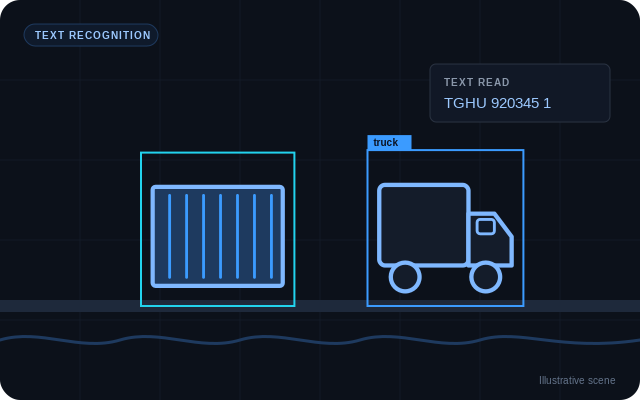
Definition
OCR converts images of text into machine-readable characters. Scene text recognition extends OCR to text in natural scenes — at angles, on curved surfaces or in variable lighting — typically by first detecting text regions and then recognizing the characters in each.
Typical outputs
- Recognized text strings with positions in the image
- Confidence per string or character
- Validated values after format checks, such as container code check digits
Where it is used
Logistics identifiers
Reading container codes, trailer numbers and shipping labels at gates and handover points.
Production labels and codes
Verifying printed dates, lot numbers and labels on packaging lines.
Gauges and displays
Reading digital displays and counters on equipment where no data interface exists.
How it works
A text-detection model finds regions that contain text. A recognition model reads the characters in each region. Post-processing validates the result against expected formats, dictionaries or check digits.
OCR as part of a use case
OCR rarely stands alone. A container code read at a gate becomes a logistics event; a date code read on a line becomes a pass or fail decision; a display reading becomes a time series. The surrounding logic decides what to do with uncertain reads.
Edge considerations
OCR models are moderate in size. The main efficiency gain comes from triggering OCR only when needed and only on cropped regions, which makes multi-camera OCR practical on Edge hardware.
Running it at the edge
Model, resolution, frame rate and hardware are planned together for each project.
Design considerations
- Capture quality first. Focus, resolution, motion blur and angle determine OCR accuracy more than the model; capture is designed before the model.
- Trigger and crop. Running OCR only when an object is in position, and only on the relevant region, reduces compute substantially.
- Format validation. Known formats and check digits catch many recognition errors before results are used.
Limitations & scope
- Dirty, damaged, partially hidden or very small text cannot be read reliably.
- Reading vehicle number plates has legal and privacy implications that must be assessed per jurisdiction.
- Machine-readable codes such as barcodes are often better read with dedicated code readers.
Proof of Concept
Have a visual AI challenge? Let's prove it.
Share a video of what happens in your environment and describe the outcome you need. We review every request for technical feasibility, then agree the scope of a focused Proof of Concept (PoC) with you.
Every request is reviewed for technical feasibility. PoC scope, timing and terms are agreed individually.
Frequently asked questions
Can OCR read text on moving objects?
Yes, if the shutter speed and resolution capture the text sharply. Motion blur is the most common cause of failure on moving objects.
Is analog gauge reading OCR?
Digital displays are read with OCR. Analog dials usually need a dedicated model that estimates needle position, which is a related but different technique.
Related topics
How this page connects to industries, use cases, AI tasks, input sources and deployment options.
Industries
- Edge AI Video Intelligence for Automotive Services
- Edge AI Video Intelligence for Consumer Goods
- Edge AI Video Intelligence for E-commerce Fulfillment
- Edge AI Video Intelligence for Food and Beverage
- Edge AI Video Intelligence for Logistics
- Edge AI Video Intelligence for Metals and Steel
- Edge AI Video Intelligence for Pharmaceuticals
- Edge AI Video Intelligence for Ports and Maritime
- Edge AI Video Intelligence for Utilities
Use Cases
- Asset Tracking and Monitoring
- Container ID Recognition
- Date and Lot Code Verification
- Drone-Based Inventory Scanning
- Equipment Monitoring
- Inventory Monitoring
- Label Inspection
- License Plate Recognition
- Meter and Gauge Reading
- Price Tag and Shelf Label Verification
- Product Detection and Verification
- Serial Number and Part Marking Reading
- Shipping Label Reading
- Slab and Coil ID Reading
- VIN Reading
- Yard and Trailer Tracking