AI TaskRotated boxes for angled objects
Oriented Object Detection (OBB)
Oriented object detection draws rotated bounding boxes that follow an object's orientation. It fits objects seen from above or at an angle — vehicles in aerial images, ships, containers, panels — far more tightly than standard axis-aligned boxes.
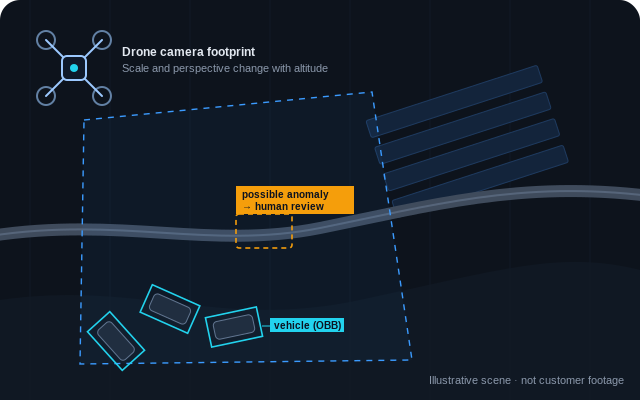
Definition
Oriented object detection predicts, for each object, a class label, a confidence score and a rotated bounding box defined by center, width, height and rotation angle, so the box aligns with the object's orientation.
Typical outputs
- Rotated bounding boxes (center, size and angle)
- Class label and confidence per object
- Object orientation, usable for heading or alignment checks
Where it is used
Aerial vehicle and asset detection
Detecting vehicles, containers or equipment in drone and aerial imagery.
Ports and yards
Locating ships, containers and trailers seen from elevated or aerial views.
Panels and structures
Aligning detections with rotated objects such as solar panels or roof elements.
How it works
An OBB model predicts the usual detection outputs plus a rotation angle. The resulting boxes fit the object closely, which improves counting, separation of neighboring objects and orientation estimates.
Where it adds value
In top-down views, objects such as vehicles or ships appear at arbitrary angles. Axis-aligned boxes around them overlap heavily and include large background areas; rotated boxes do not.
Edge considerations
OBB runs on the same classes of Edge hardware as standard detection. Aerial workflows often combine onboard detection for time-critical needs with post-flight processing for detailed analysis.
Running it at the edge
Model, resolution, frame rate and hardware are planned together for each project.
Design considerations
- Aerial resolution. Small objects in high-altitude imagery need high-resolution inputs or tiling, which increases compute.
- Tiling large images. Large aerial images are often split into tiles for processing and the results merged, which suits batch or post-flight analysis.
- Onboard versus post-flight. Onboard OBB analysis is possible on capable drone compute payloads; post-flight processing allows larger models.
Limitations & scope
- Rotation-labeled training data is more effort to create than standard boxes.
- Very small or densely packed objects remain challenging at high altitude.
- Orientation estimates near symmetrical shapes can be ambiguous.
Proof of Concept
Have a visual AI challenge? Let's prove it.
Share a video of what happens in your environment and describe the outcome you need. We review every request for technical feasibility, then agree the scope of a focused Proof of Concept (PoC) with you.
Every request is reviewed for technical feasibility. PoC scope, timing and terms are agreed individually.
Frequently asked questions
When should I use OBB instead of standard detection?
When objects appear at various rotations, as in top-down aerial imagery, where axis-aligned boxes would include large amounts of background or overlap neighboring objects.
Is OBB only for drones?
No. It suits any view where objects are rotated, including elevated fixed cameras over yards and ports.
Related topics
How this page connects to industries, use cases, AI tasks, input sources and deployment options.