Use CaseConveyor and tray picking
Pick-and-Place Guidance
Locate products on conveyors, trays or tables and guide robots to pick and place them, supporting packing, kitting and line-feeding tasks.
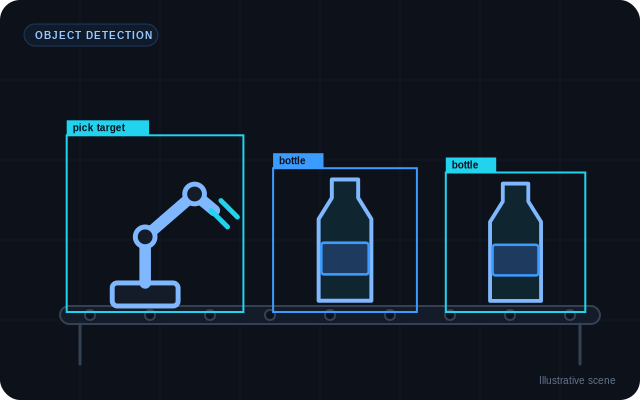
What can be checked
- Products on a moving conveyor
- Product position and rotation
- Free places in trays or boxes
What the team receives
- Pick coordinates with timestamps
- Placement targets
What the solution does
Higher automation
Locates products in random positions and orientations on conveyors, so robots can pick them without mechanical alignment.
Mixed products
Recognizes several product types on the same line, so one cell can handle mixed or changing product ranges.
Throughput
Keeps pace with moving conveyors in typical packing applications.
The operational problem
Manual pick-and-place on packing lines is repetitive, physically demanding and difficult to staff. Products arrive in random positions, which rules out simple fixed robot programs.
How visual intelligence helps
A camera upstream of the robot locates each product and its rotation. Positions are tracked with the conveyor encoder so the robot can pick moving products and place them in trays or cartons.
Example visual workflow
- A camera images products upstream of the robot.
- Products are located and classified.
- Positions are tracked along the conveyor.
- The robot picks and places each product.
Illustrative workflow — the actual pipeline is designed for each site during the PoC.
Edge deployment considerations
Vision runs next to the robot with tight synchronization to conveyor motion. Latency and timing are validated on the real line during the PoC.
How the solution is built
AI capabilities
The AI tasks this use case combines.
- Object Detection
Object detection finds and labels the objects in an image or video frame and marks each one with a bounding box.
- Oriented Object Detection (OBB)
Oriented object detection draws rotated bounding boxes that follow an object's orientation.
Visual inputs
Cameras and imaging that typically supply the video.
- Industrial and Machine Vision Cameras
Industrial and machine vision cameras capture sharp, consistent images at fixed positions with controlled lighting and triggering.
- Robotic Vision
Robotic vision places cameras on or around robot arms to guide picking, placement, assembly and inspection.
Deployment options
General approaches to evaluate, not tested hardware. Specific hardware is selected and validated for each project during the PoC.
- Edge AI Hardware Sizing
Sizing Edge AI hardware means matching compute, memory, power and enclosure to the real workload — the number of streams, resolution, frame rate, models and latency targets — under the site's environmental and installation constraints.
- Edge Deployment Architectures
Edge-first means processing video at or near where it is captured.
- Industrial and Ruggedized Edge AI Computers
Industrial Edge AI computers and ruggedized systems house AI-capable processors in enclosures built for factories, vehicles and outdoor sites — wide temperature ranges, vibration, dust and industrial power.
Practical factors to plan for
Real-world results depend as much on the environment and camera setup as on the model.
Site and setup
- Conveyor tracking. Coordinates must be synchronized with conveyor encoders.
- Mixed products. Each product type needs recognition.
Human review
Operators monitor pick rates and handle missed products.
Limitations & scope
- Overlapping products may not be pickable.
- Very high speeds need specialized robots.
Proof of Concept
Have a visual AI challenge? Let's prove it.
Share a video of what happens in your environment and describe the outcome you need. We review every request for technical feasibility, then agree the scope of a focused Proof of Concept (PoC) with you.
Example request: “We want a robot to pick randomly placed pouches from a conveyor into cartons.”
Every request is reviewed for technical feasibility. PoC scope, timing and terms are agreed individually.
Related topics
How this page connects to industries, use cases, AI tasks, input sources and deployment options.