IndustryPower generation and renewables
Edge AI Video Intelligence for Energy
Power plants, substations, solar farms and wind sites are large, often remote and safety-critical. Edge AI video intelligence can support inspection, perimeter security and safety monitoring using fixed, thermal and aerial cameras — processed close to the asset.
Common challenges
- Assets are spread across large or remote areas that are costly to inspect in person.
- Thermal anomalies and physical damage can develop between scheduled inspections.
- Substations and plants are attractive targets for intrusion and theft.
- Connectivity at remote sites is often limited or intermittent.
Typical visual sources
- Thermal and infrared cameras on critical equipment
- Drones for solar, wind and line inspection
- Fixed IP and PTZ cameras on perimeters and switchyards
Potential applications
Visual and thermal inspection
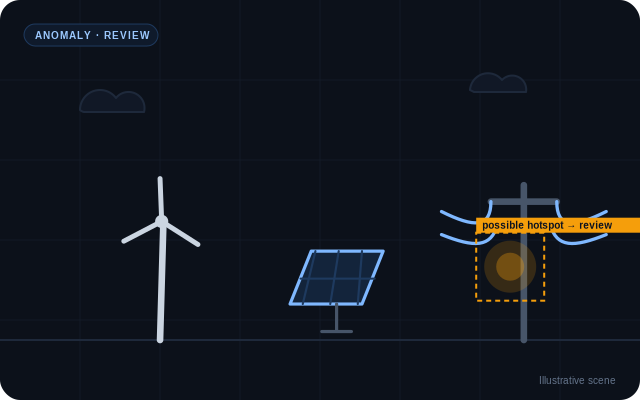
Flag possible hotspots, damage or soiling on panels, transformers and other equipment for engineering review.
Perimeter monitoring
Detect people or vehicles approaching fences and restricted areas of remote sites.
Safety around energized equipment
Detect people entering defined restricted areas and check required protective equipment.
Equipment state monitoring
Observe gauges, indicators and visible equipment conditions where sensors are absent.
Large, distributed, critical assets
Energy assets are expensive, safety-critical and often far from the people who maintain them. Video and thermal imagery from fixed cameras, drones and inspection robots can extend how often assets are seen, and Edge AI can highlight what deserves attention so experts spend their time on the right issues.
Why Edge processing fits
Remote sites rarely have bandwidth for continuous video. Analyzing footage on site, or on a drone or ground station, sends only findings and selected images onward. Cloud services can complement this for fleet-wide reporting and model improvement when required.
Questions to answer early
- Which assets and failure modes matter most?
- Is the imagery RGB, thermal or both, and from which platforms?
- How should findings reach engineering and maintenance teams?
Limitations & scope
- Thermal analysis indicates relative temperature differences; it supports, but does not replace, qualified thermographic inspection.
- Drone operations are subject to aviation rules and site permissions that remain the operator's responsibility.
- Outdoor conditions — weather, glare, night and seasonal change — must be represented in evaluation footage.
Proof of Concept
Have a visual AI challenge? Let's prove it.
Share a video of what happens in your environment and describe the outcome you need. We review every request for technical feasibility, then agree the scope of a focused Proof of Concept (PoC) with you.
Example request: “We want to flag possible hotspots in thermal drone footage of our solar arrays for an engineer to review.”
Every request is reviewed for technical feasibility. PoC scope, timing and terms are agreed individually.
Frequently asked questions
Can Edge AI run at remote substations?
Yes, provided suitable power and an enclosure rated for the environment are available. Processing locally means only events, not continuous video, need to cross the site link.
Can drone imagery from solar farms be analyzed automatically?
Drone RGB and thermal imagery can be analyzed to flag possible panel issues for review. Feasibility depends on flight altitude, image quality and the defect types involved.
Related topics
How this page connects to industries, use cases, AI tasks, input sources and deployment options.
Use Cases
- Corrosion Detection
- Engine Borescope Inspection Support
- Equipment Monitoring
- Fire and Smoke Detection
- Flare Monitoring
- Gas Leak Indicators with Optical Imaging
- Industrial Visual Inspection
- Meter and Gauge Reading
- Perimeter Monitoring and Intrusion Detection
- Pipeline Right-of-Way Monitoring
- Power Line Inspection
- Restricted Area Monitoring
- Solar Panel Inspection
- Stockpile Volume Estimation
- Substation Monitoring
- Thermal Equipment Monitoring
- Wind Turbine Blade Inspection
- Working at Height Safety Awareness