Use CaseAssets, structures and infrastructure
Industrial Visual Inspection
Analyze imagery of industrial assets — pipelines, tanks, structures, solar fields, lines and equipment — captured by drones, robots, vehicles or fixed cameras, to highlight possible damage or anomalies for engineers.
What can be checked
- Possible corrosion, cracks, deformation or missing components
- Thermal hotspots where thermal imagery is used
- Vegetation encroachment or obstructions near assets
- Soiling, debris or damage on panels and surfaces
What the team receives
- Findings with image, location and category for engineering review
- Prioritized inspection lists
- Change comparisons between inspection rounds
What the solution does
Focuses expert time
Reviews large volumes of imagery and highlights the small share that needs an engineer's attention.
Consistent criteria
Applies the same detection criteria across inspection rounds and assets.
Works with many platforms
Uses imagery from drones, robots, vehicles or fixed cameras.
The problem
Inspecting industrial assets is costly, sometimes dangerous, and generates large amounts of imagery that experts must review. Much of that imagery shows nothing of concern.
How visual intelligence helps
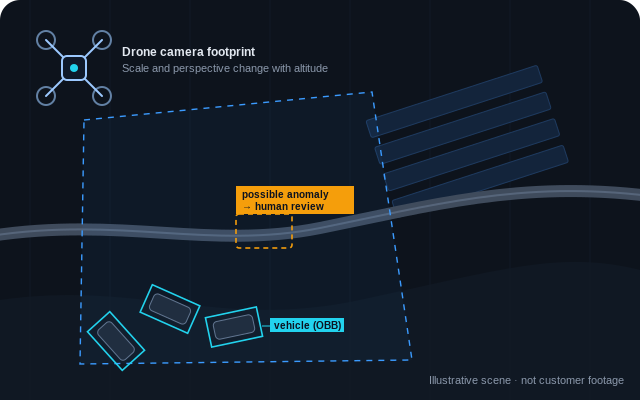
Detection, segmentation and anomaly-detection models highlight possible issues; oriented boxes help with rotated objects in aerial views. Findings are linked to locations and prioritized for review.
Deployment considerations
Analysis can run onboard capable platforms, on a ground station, or after the mission. Hybrid architectures send findings to central asset-management systems.
How the solution is built
AI capabilities
The AI tasks this use case combines.
- Defect Detection
Defect detection locates and classifies specific, known defect types — scratches, cracks, dents, contamination, missing features — in images of products or assets.
- Oriented Object Detection (OBB)
Oriented object detection draws rotated bounding boxes that follow an object's orientation.
- Semantic Segmentation
Semantic segmentation assigns a class to every pixel of an image — road, floor, water, smoke, crop, background — producing a map of regions rather than individual objects.
- Visual Anomaly Detection
Visual anomaly detection learns what normal looks like and flags images, regions or events that deviate from it.
Visual inputs
Cameras and imaging that typically supply the video.
- Drones & UAVs
Drones capture visual data where fixed cameras cannot reach — long perimeters, large sites, tall structures and remote assets.
- Mobile Robots and AMRs
Mobile robots — autonomous mobile robots (AMRs), quadrupeds and inspection robots — carry cameras through facilities and sites on repeatable routes.
- Thermal and Infrared Cameras
Thermal cameras image heat (long-wave infrared), while near-infrared cameras use invisible illumination to see in darkness.
- Vehicle-Mounted Cameras
Cameras on trucks, rail vehicles, forklifts, buses and service vehicles capture visual data while moving — for road and rail inspection, operational safety and fleet operations.
Deployment options
General approaches to evaluate, not tested hardware. Specific hardware is selected and validated for each project during the PoC.
- Edge AI Hardware Sizing
Sizing Edge AI hardware means matching compute, memory, power and enclosure to the real workload — the number of streams, resolution, frame rate, models and latency targets — under the site's environmental and installation constraints.
- Edge Deployment Architectures
Edge-first means processing video at or near where it is captured.
- Hybrid Edge + Cloud Architecture
In a hybrid architecture, time-critical video analysis runs at the edge while selected functions — central dashboards, long-term storage, fleet management or model improvement — run in the Cloud.
- Industrial and Ruggedized Edge AI Computers
Industrial Edge AI computers and ruggedized systems house AI-capable processors in enclosures built for factories, vehicles and outdoor sites — wide temperature ranges, vibration, dust and industrial power.
- Standalone Edge AI Devices
Standalone Edge AI devices are compact, self-contained units — AI boxes or smart cameras — that process video locally at a single location.
Practical factors to plan for
Real-world results depend as much on the environment and camera setup as on the model.
Site and setup
- Capture consistency. Repeatable flight paths, robot routes or camera positions make comparisons over time far more reliable.
- Resolution versus coverage. Detecting small defects needs close or high-resolution imagery, which trades off against coverage per flight.
- Location data. Linking findings to asset IDs needs GPS, route or asset-map data alongside the imagery.
Human review
Findings are assessed by qualified engineers. Structural or integrity decisions are never made by the model alone.
Limitations & scope
- Only visible surface conditions can be detected; internal defects require other inspection methods.
- Inspection regimes required by regulation or standards remain in force.
- Performance is validated per asset type and defect class on real inspection imagery.
Proof of Concept
Have a visual AI challenge? Let's prove it.
Share a video of what happens in your environment and describe the outcome you need. We review every request for technical feasibility, then agree the scope of a focused Proof of Concept (PoC) with you.
Example request: “We want to highlight possible corrosion in drone footage of our storage tanks for our engineers to review.”
Every request is reviewed for technical feasibility. PoC scope, timing and terms are agreed individually.
Frequently asked questions
How is this different from quality inspection?
Quality inspection checks products during manufacturing. Industrial visual inspection checks assets and infrastructure in operation.
Can analysis happen during the flight?
Sometimes, on platforms with suitable onboard compute. Post-flight analysis is often simpler and allows larger models.
Related topics
How this page connects to industries, use cases, AI tasks, input sources and deployment options.