AI TaskPrompted detection, captions and visual questions
Vision-Language Analysis
Vision-language models connect images with text. They can detect or segment objects named in a prompt, describe a scene, or answer a question about an image — useful for rapid prototyping, rare classes and flexible review, alongside specialized models for production workloads.
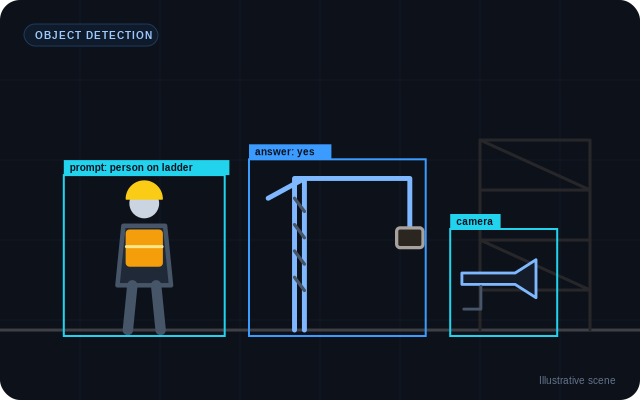
Definition
Vision-language analysis covers models trained on images and text together. Open-vocabulary detectors and segmenters find objects described in words without class-specific training; multimodal models produce captions or answer questions about an image. They trade speed and predictability for flexibility.
Typical outputs
- Detections or masks for objects named in a text prompt
- Natural-language descriptions of images or clips
- Answers to defined questions, such as whether a condition is visible
Where it is used
Fast prototyping
Testing whether a condition can be recognized before collecting training data.
Rare or changing classes
Finding objects that are too rare or varied for a fixed detector.
Assisted review
Summarizing flagged events or answering checklist questions for human reviewers.
How it works
Vision-language models learn a shared representation of images and text. Prompted detectors use it to find objects described in words; multimodal models generate text from images. Outputs are turned into structured events by constraining prompts and answers.
Where it fits in a project
Vision-language models are a strong starting point for exploring a problem and handling rare cases. Once requirements are clear, a specialized model trained on site data often takes over continuous work.
Edge considerations
Smaller vision-language models and prompted detectors run on capable Edge hardware. Larger models can be reserved for selected frames in a hybrid design, with clear rules on what leaves the site.
Running it at the edge
Model, resolution, frame rate and hardware are planned together for each project.
Design considerations
- Model size. Large multimodal models need substantial compute; smaller variants and prompted detectors fit Edge hardware better.
- Hybrid use. A fast specialized model can run continuously at the edge and send only selected frames to a larger model.
- Consistency. Free-text outputs vary; structured prompts and fixed answer options make results easier to validate.
Limitations & scope
- Prompted models are usually slower and less predictable than a trained detector for a fixed task.
- Outputs can be confidently wrong; they need validation and human review for consequential decisions.
- Sending images to external model APIs requires agreement on data handling; Edge or self-hosted options avoid this.
Proof of Concept
Have a visual AI challenge? Let's prove it.
Share a video of what happens in your environment and describe the outcome you need. We review every request for technical feasibility, then agree the scope of a focused Proof of Concept (PoC) with you.
Example request: “We want to test whether a prompted model can flag ladders left standing in aisles before we invest in training data.”
Every request is reviewed for technical feasibility. PoC scope, timing and terms are agreed individually.
Frequently asked questions
Can a vision-language model replace a trained detector?
For prototypes and rare cases it can help. For continuous, high-volume production use, a trained specialized model is typically faster, cheaper to run and easier to validate.
Does this send our images to the Cloud?
Only if the design uses an external API and you agree. Self-hosted and Edge-sized models keep images on site.
Related topics
How this page connects to industries, use cases, AI tasks, input sources and deployment options.