AI TaskInterpreting the whole view
Scene Understanding
Scene understanding interprets an image as a whole — what kind of place it is, which objects are present, how they relate and what state the area is in. It combines several tasks and increasingly uses vision-language models to answer questions about a scene.
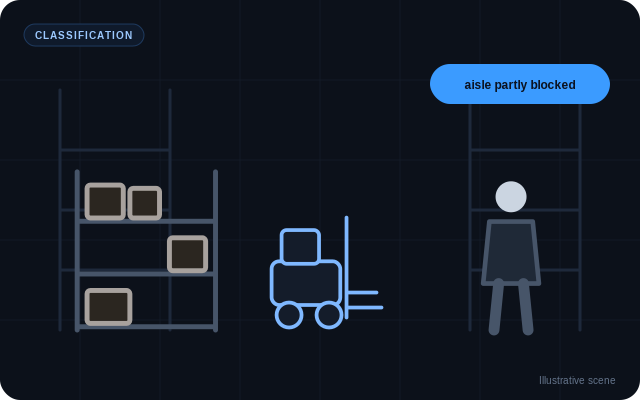
Definition
Scene understanding is an umbrella term for interpreting an entire scene, combining scene classification, object detection, segmentation and spatial relationships. Vision-language models extend it by describing scenes or answering natural-language questions about images.
Typical outputs
- Scene-level labels or states, such as "walkway blocked" or "dock idle"
- Object lists with relationships, such as "pallet in front of exit"
- Text descriptions or answers from vision-language models
Where it is used
Area state checks
Determining whether an area is clear, blocked, occupied or in a particular configuration.
Housekeeping and compliance
Checking the overall state of workplaces, exits and storage areas.
Searching and summarizing footage
Supporting search and summaries of recorded video using natural-language descriptions.
How it works
Traditional scene understanding combines several specialized models — classification for the scene, detection for objects, segmentation for regions — and reasons over their outputs. Vision-language models take an image and a text prompt and produce a text answer, offering flexibility at higher compute cost.
Practical use
For operations, scene understanding works best as clearly defined states: “exit blocked”, “bay empty”. Open-ended descriptions are useful for search and summaries but harder to rely on for alerts.
Edge and Cloud balance
Focused models run well at the edge. Larger vision-language models are a case where Cloud-assisted processing on selected frames may be justified, if data policies allow.
Running it at the edge
Model, resolution, frame rate and hardware are planned together for each project.
Design considerations
- Composite pipelines. Many scene-level questions are answered more reliably by combining focused models with rules than by one general model.
- Vision-language models are heavy. Larger vision-language models need substantial compute; Edge use usually relies on smaller models or runs them on selected frames only.
- Verifiable outputs. Free-text outputs are harder to validate than structured events; structured outputs are preferred for operations.
Limitations & scope
- General scene models can be confidently wrong; outputs need validation for operational decisions.
- Vision-language models may require Cloud-scale compute; Edge feasibility depends on model size and frame rate.
- Broad questions are harder to validate than narrow ones; narrow, testable definitions work best.
Proof of Concept
Have a visual AI challenge? Let's prove it.
Share a video of what happens in your environment and describe the outcome you need. We review every request for technical feasibility, then agree the scope of a focused Proof of Concept (PoC) with you.
Every request is reviewed for technical feasibility. PoC scope, timing and terms are agreed individually.
Frequently asked questions
Can I ask questions about my camera footage in plain language?
Vision-language models make this possible to a degree, but answers must be validated. For operational alerts, structured detection and rules are usually more reliable.
Is scene understanding a separate model?
Usually it is a combination of tasks. Vision-language models provide a more general, single-model approach with different trade-offs.
Related topics
How this page connects to industries, use cases, AI tasks, input sources and deployment options.