Use CaseDents, scratches and missing fasteners
Aircraft Surface Inspection
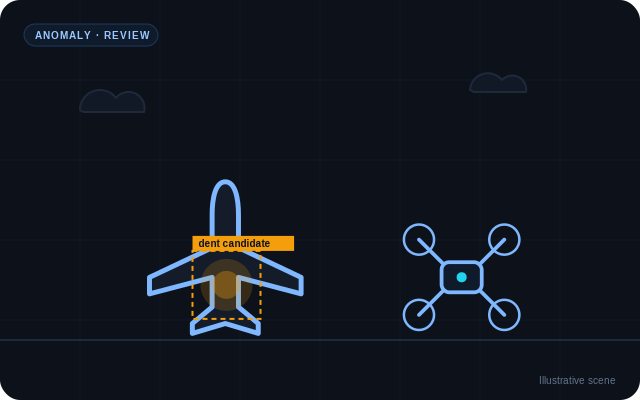
Analyze drone or camera imagery of fuselages, wings and control surfaces to highlight possible dents, scratches, paint damage and missing fasteners for review by certified inspectors.
What can be checked
- Possible dents and surface deformations
- Scratches and paint or coating damage
- Missing or protruding fasteners
What the team receives
- Annotated images with finding locations
- Inspection report draft for inspector sign-off
What the solution does
Broader coverage
Scans large surfaces more consistently than manual walk-arounds alone.
Directed attention
Points inspectors to areas that deserve a closer look.
Traceable records
Keeps an image for every finding to support documentation.
The operational problem
General visual inspections of airframes are long, repetitive and depend on inspector experience and lighting. Large surfaces make it easy to miss small damage, and documentation is often a manual step after the inspection.
How visual intelligence helps
Imagery from drones or camera rigs is analyzed for visual anomalies such as dents, scratches and missing fasteners. Candidate findings are ranked and located on the airframe so inspectors spend their time confirming real issues rather than searching.
Example visual workflow
- A drone or camera rig captures the airframe along a planned path.
- Images are analyzed on a ground Edge computer for candidate findings.
- Findings are mapped to aircraft zones and ranked for review.
- An inspector confirms or rejects each finding and signs the record.
Illustrative workflow — the actual pipeline is designed for each site during the PoC.
Edge deployment considerations
Analysis usually runs on a ground station or hangar Edge computer, so large image sets are processed without uploading them. Results and images are stored under the operator’s quality system.
How the solution is built
AI capabilities
The AI tasks this use case combines.
- Defect Detection
Defect detection locates and classifies specific, known defect types — scratches, cracks, dents, contamination, missing features — in images of products or assets.
- Visual Anomaly Detection
Visual anomaly detection learns what normal looks like and flags images, regions or events that deviate from it.
Visual inputs
Cameras and imaging that typically supply the video.
- Drones & UAVs
Drones capture visual data where fixed cameras cannot reach — long perimeters, large sites, tall structures and remote assets.
- Mobile Device Cameras
Smartphones and tablets put capable cameras and processors in the hands of field teams.
Deployment options
General approaches to evaluate, not tested hardware. Specific hardware is selected and validated for each project during the PoC.
- Edge AI Hardware Sizing
Sizing Edge AI hardware means matching compute, memory, power and enclosure to the real workload — the number of streams, resolution, frame rate, models and latency targets — under the site's environmental and installation constraints.
- Edge Deployment Architectures
Edge-first means processing video at or near where it is captured.
- Hybrid Edge + Cloud Architecture
In a hybrid architecture, time-critical video analysis runs at the edge while selected functions — central dashboards, long-term storage, fleet management or model improvement — run in the Cloud.
- Standalone Edge AI Devices
Standalone Edge AI devices are compact, self-contained units — AI boxes or smart cameras — that process video locally at a single location.
Practical factors to plan for
Real-world results depend as much on the environment and camera setup as on the model.
Site and setup
- Reflective surfaces. Polished and painted skins reflect light; capture angle and diffuse lighting matter a lot.
- Positioning. Findings must be mapped to aircraft zones so inspectors can locate them quickly.
Human review
Every finding is reviewed by a certified inspector. The system does not make airworthiness decisions or replace mandated inspections.
Limitations & scope
- Very small or subtle dents may not be visible without specialized lighting.
- Internal or subsurface damage requires non-destructive testing.
Proof of Concept
Have a visual AI challenge? Let's prove it.
Share a video of what happens in your environment and describe the outcome you need. We review every request for technical feasibility, then agree the scope of a focused Proof of Concept (PoC) with you.
Example request: “We want to flag possible dents in drone imagery of A320 fuselages captured in our hangar.”
Every request is reviewed for technical feasibility. PoC scope, timing and terms are agreed individually.
Frequently asked questions
Is this accepted by aviation authorities?
Acceptance depends on the operator's approved maintenance program. Analytics are typically introduced as an aid to existing procedures.
Related topics
How this page connects to industries, use cases, AI tasks, input sources and deployment options.