IndustryAircraft production and MRO
Edge AI Video Intelligence for Aerospace
Aerospace manufacturing and maintenance demand meticulous visual inspection of large, high-value structures under strict documentation rules. Edge AI video intelligence can support surface inspection, foreign-object awareness and process verification — as decision support for certified inspectors.
Common challenges
- Visual inspection of fuselages, wings and engines is slow and depends on individual inspector experience.
- Foreign object debris in hangars, assembly areas and on aprons creates safety and damage risk.
- Composite structures can show subtle surface defects that are easy to miss.
- Every inspection step must be documented and traceable.
Typical visual sources
- Drones and mobile cameras for inspecting large airframe surfaces
- Industrial cameras at composite layup and assembly stations
- Fixed cameras in hangars, assembly halls and apron areas
Potential applications
Airframe surface inspection
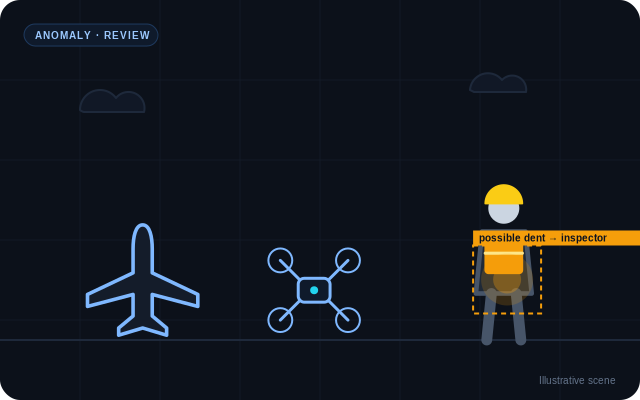
Highlight possible dents, scratches or missing fasteners in imagery of fuselage and wing surfaces for inspector review.
Foreign object awareness
Flag tools, parts or debris left in work zones or on aprons before they cause damage.
Composite process checks
Support visual checks of layup, ply placement and surface condition at production stations.
Hangar process visibility
Record when key maintenance steps occur to support planning and documentation.
Where video intelligence fits
Aerospace combines very large structures with very small acceptable defects. Video intelligence helps by scanning more surface area more consistently and directing experienced inspectors to the areas that deserve a closer look, while keeping every finding traceable to an image.
Typical Edge architecture
Processing typically runs on an Edge computer in the hangar or at the production cell, with imagery and findings stored on site under the organization’s quality system. Cloud services may support fleet-wide analysis where data policies allow.
Questions to answer early
- Which inspection step is most time-consuming or error-prone today?
- How must findings be documented to fit the quality system?
- Can lighting and capture positions be standardized?
Limitations & scope
- Airworthiness decisions remain with certified personnel; analytics provide decision support only.
- Inspection procedures are governed by regulation and manufacturer documentation that video analytics does not replace.
- Reflective, curved surfaces require careful lighting and capture design.
Proof of Concept
Have a visual AI challenge? Let's prove it.
Share a video of what happens in your environment and describe the outcome you need. We review every request for technical feasibility, then agree the scope of a focused Proof of Concept (PoC) with you.
Example request: “We want to flag possible surface dents in hangar imagery of narrow-body fuselages for our inspectors.”
Every request is reviewed for technical feasibility. PoC scope, timing and terms are agreed individually.
Frequently asked questions
Can drones inspect aircraft in a hangar?
Drone-based visual inspection of airframes is an emerging practice. Feasibility depends on the hangar, the aircraft type and the approval of the operator's quality system.
Does this replace non-destructive testing?
No. Visual analytics covers surface conditions. Internal defects still require NDT methods.
Related topics
How this page connects to industries, use cases, AI tasks, input sources and deployment options.
Use Cases
- Aircraft Surface Inspection
- Aircraft Turnaround Monitoring
- Composite Defect Inspection
- Engine Borescope Inspection Support
- Fastener and Rivet Inspection
- Foreign Object Debris (FOD) Detection
- Robotic Visual Inspection
- Serial Number and Part Marking Reading
- Tool Presence Verification
- Wire Harness and Connector Inspection