Use CaseGround handling milestones at the gate
Aircraft Turnaround Monitoring
Record when ground-handling milestones happen at the gate — chocks on, bridge connected, fueling, catering, baggage loading — to give operations teams objective turnaround timelines.
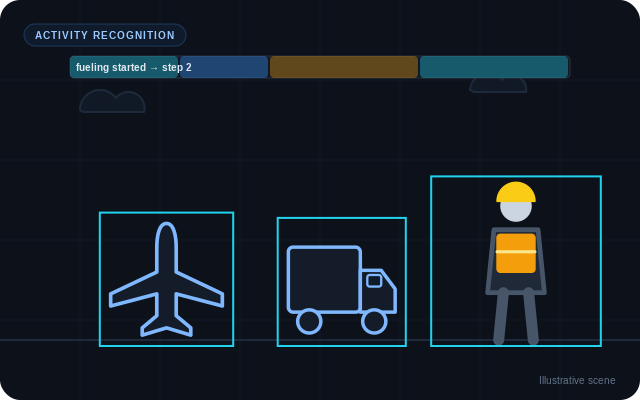
What can be checked
- Arrival and departure of aircraft at the stand
- Presence of ground vehicles such as fuel trucks and loaders
- Start and end of handling activities
What the team receives
- Milestone timestamps per turnaround
- Delay indicators for operations dashboards
What the solution does
Objective timelines
Replaces manual milestone entries with consistent timestamps.
Delay insight
Shows which handling step caused a delay.
Stand-level data
Supports planning across stands and handlers.
The operational problem
Turnaround milestones are often entered manually or by radio calls, which creates gaps and inconsistent data. Delays are hard to attribute to a specific handling step.
How visual intelligence helps
Stand cameras observe the aircraft and service vehicles, and activity recognition timestamps each milestone. Operations teams get a consistent timeline for every turnaround.
Example visual workflow
- Stand cameras stream to an Edge server at the airport.
- Models detect the aircraft and service vehicles and recognize activities.
- Milestones are timestamped and grouped per turnaround.
- Timelines are shared with operations systems.
Illustrative workflow — the actual pipeline is designed for each site during the PoC.
Edge deployment considerations
Airport networks and policies usually require on-premises processing. An Edge server per terminal can handle several stands, sending only milestone events to operations systems.
How the solution is built
AI capabilities
The AI tasks this use case combines.
- Action and Activity Recognition
Action recognition identifies short actions — picking, lifting, opening a door — while activity recognition describes longer sequences such as a loading operation or a procedure.
- Object Detection
Object detection finds and labels the objects in an image or video frame and marks each one with a bounding box.
Visual inputs
Cameras and imaging that typically supply the video.
- CCTV and Existing Surveillance Systems
Many sites already run CCTV systems — analog cameras, DVRs, NVRs and video management systems.
- IP and Network Cameras
IP cameras stream digital video over standard networks and are the most common source for Edge AI video analytics.
Deployment options
General approaches to evaluate, not tested hardware. Specific hardware is selected and validated for each project during the PoC.
- Camera and VMS Integration
Most projects start with cameras that are already installed.
- Edge AI Hardware Sizing
Sizing Edge AI hardware means matching compute, memory, power and enclosure to the real workload — the number of streams, resolution, frame rate, models and latency targets — under the site's environmental and installation constraints.
- Edge Deployment Architectures
Edge-first means processing video at or near where it is captured.
- Industrial and Ruggedized Edge AI Computers
Industrial Edge AI computers and ruggedized systems house AI-capable processors in enclosures built for factories, vehicles and outdoor sites — wide temperature ranges, vibration, dust and industrial power.
Practical factors to plan for
Real-world results depend as much on the environment and camera setup as on the model.
Site and setup
- Camera coverage. One or two cameras per stand must see the aircraft and service vehicles.
- Activity definitions. Each milestone needs a clear visual definition agreed with operations.
Human review
Operations staff use timelines for planning and delay analysis. Milestone data is reviewed before it is used in disputes or reporting.
Limitations & scope
- Occlusion by vehicles and weather can hide parts of the activity.
- Milestones that are not visible cannot be recorded.
Proof of Concept
Have a visual AI challenge? Let's prove it.
Share a video of what happens in your environment and describe the outcome you need. We review every request for technical feasibility, then agree the scope of a focused Proof of Concept (PoC) with you.
Example request: “We want automatic timestamps for chocks-on, bridge connection and fueling at four contact stands.”
Every request is reviewed for technical feasibility. PoC scope, timing and terms are agreed individually.
Related topics
How this page connects to industries, use cases, AI tasks, input sources and deployment options.